Showing posts with label science fiction. Show all posts

Monday, January 2, 2012

Cosmic by Frank Cottrell Boyce

This plot is awesome. The whole book is awesome, but the plot just takes the cake. It reminds me more than a little of a modern Charlie and the Chocolate Factory, with eccentric adults and a competition that's far more than it's advertised. But...well, just look at this plot.

Liam Digby is only twelve, but he's unusually tall and has premature facial hair--just a little of it, but enough to make him look stubbly. He doesn't love being called Wolverine or being treated like he's older than he really is just because he's tall (and stubbly), but the worst part is when his mother decides he needs to make friends. He points out that he has "loads of friends. I've got twenty guild members just waiting to do my bidding" (p. 27), but his mom means real life friends, not World of Warcraft.

So Liam's sent to Little Stars drama club, where he's stuck playing the giant alongside his classmate Florida. But a funny thing happens when they hang out at the mall after the meetings: people think Liam is an adult, and Florida is his daughter. Naturally Liam pushes this as far as a Porsche test drive; but when he's mistaken for his own father and wins a competition for great dads where he's one of four dads invited to a brand new adventure park in China--and since he has to show up with a "daughter," he convinces Florida to come with him.

And that is just the beginning of the book.

Liam is smart, thoughtful, enthusiastic, and likable. He applies what he's learned in World of Warcraft to real life--with generally good results. He wants to travel and is frustrated that he lives in a town named Waterloo in Britain when he could live in the Waterloo in Sierra Leone or somewhere equally exotic. Of course he's going to head to China the first chance he gets.

What I love most about the book--and it's a hard choice, because this book is freaking hilarious as well as entertaining--is how it quietly explores what it means to be a dad. It's charming and funny, and the plot zigzags from absurdity to absurdity without anything feeling stupid. My only complaint is the crappy Americanization of Mum to Mom and football to soccer--jarring, halfassed, and needless, since I don't think there's a kid in America who would be confused by the original terms. Other terms, like crisps instead of chips and biscuit instead of cookie, aren't changed.

Anyway, I loved this book so much I may reread it pretty soon just to make sure I caught all the jokes. I also know what book I'm giving my oldest nephew for his birthday this year. Incidentally, the science in this book is good too. It's all good.

B&N link

Saturday, December 24, 2011

Trillions by Nicholas Fisk

One of my favorite books as a middle-schooler was Monster Maker by Nicholas Fisk. I must have checked it out of the library a dozen times, and I was thrilled when I found my own copy years ago. But that was the only Fisk book the library had. A few months ago I went looking for more of his books, and the only one I could find was this one, Trillions.

I expected to love it. It's science fiction, about millions--trillions--of tiny aliens that land on earth. As far as I could guess from the text (which is not clear on their size), the trillions are about the size of a grain of sand, and while they can move and interlock, they don't do anything else. They heap up in drifts like sand dunes, occasionally join together to imitate nearby structures, and are gathered by children because they glitter prettily in different colors. The book introduces four children, two boys and two girls, and I was looking forward to seeing what Fisk would do with such a fascinating concept.

The answer: not much. The book was published in 1971, which explains (I suppose) why the boys are the ones who do things while the girls make bracelets out of the trillions and act babyish. It doesn't explain why the entire world in this book thinks banding together to obliterate the trillions with nuclear weapons is a good choice. Remember, the trillions don't actually hurt anything. There are a few small examples given of the trillions imitating rockets (although they aren't rockets) and inadvertently causing an old man to have a heart attack, and the entire world except for one schoolboy thinks that makes them enemies. There are lots of scenes of generals shouting about taking ACTION against the trillions--which do nothing, keep in mind. Also, English children are required to leave school so they can shovel up trillions into wagons and dump them in a big pile, overseen by soldiers. This continues throughout the whole book and doesn't make any sense. Nothing much makes any sense.

The main character, sort of, is a boy named Scott. Through a combination of telepathy and handwavium, Scott learns how to communicate in a limited way with the trillions. He doesn't share this information with anyone, and although I read the damn book I still don't know why he doesn't. But that's the problem with this book: it's just got an axe to grind about people ruining the environment, and the army being, I don't know, evil or something and too ready to set off those nasty nuclear weapons--which cause some fish and birds and trees to die, but don't seem to hurt people (or the environment).

Even if the plot did make any sense--and really, it doesn't--the writing is awful. The book reads like an outline, an overview. Not only that, not much happens--and when it does, it's really too late. Why didn't Scott act sooner? Well, if he had, Fisk would had had to work out an actual plot to go with his idea.

B&N link (used book)

Friday, November 18, 2011

Fuzzy Nation by John Scalzi


Fuzzy Nation is a fast, fun read--much more fun than I expected. Jack Holloway is a contractor for ZaraCorp, and a wiseass. Everyone likes his dog, though. Jack's in prime position to become a multi-millionaire--even a billionaire--after he discovers a motherlode of sunstones on a planet he's prospecting for his employer. Then he discovers something else, a species of animal native to the planet that he calls fuzzys. The trouble is, the fuzzys may be more than just animals. And if they're sentient, Jack's billions may go up in smoke--along with the fuzzys themselves.

The writing is easy, confident, and fast-paced. It's also frequently funny. The fuzzys are appealing as well as believable SF creatures, and no one I know of writes dogs as well as Scalzi does. And there are moments in the book when I wanted to jump up out of my chair, do a fist-pump, and shout, "YES!" It's a really fun book.

In tone, Fuzzy Nation is very similar to Scalzi's Agent to the Stars, which I read earlier this year and liked okay. But the flaws in that book are not found in Fuzzy Nation, which has a tighter, more believable plot. I really need to read some of Scalzi's other books, because at this point I'm wanting to say that he basically only has a few characters and he recasts them over and over, but I'm probably wrong. This one just feels an awful lot like Agent to the Stars.

I thought I'd read Little Fuzzy by H. Beam Piper when I was a kid, the book on which Fuzzy Nation was based, but I must be wrong because nothing about Scalzi's book rang any bells. I'm probably thinking of a different book. After reading Little Fuzzy, though, I'm definitely keen on reading Piper's original story to compare the two.

B&N link

Sunday, November 6, 2011

The True Meaning of Smekday by Adam Rex

The True Meaning of Smekday starts off as an essay written by Gratuity (her friends call her Tip) Tucci as a class assignment, but Tip has a big story to tell and keeps writing even after her essay is finished.

Tip's story happens after the aliens--the Boov--landed and defeated Earth pretty handily. The Boov have decided they want most of the Earth to themselves, so they're moving the humans to colonies. Everyone in America, for instance, has to go to Florida. Tip's mother has been kidnapped, possibly killed, by the Boov, but Tip hasn't told anyone. Rather than go in the alien ships with most people, Tip gathers up her cat, named Pig, and decides to drive from Pennsylvania to Florida. She's a good driver for an eleven-year-old.

But she hasn't gone far when she's shot at by the Boov and wrecks her car. While she's trying to find food at an abandoned convenience store, she encounters a Boov who doesn't try to kill her. In fact, he's friendly. He fixes her car and asks for a ride. She agrees reluctantly, and the book takes off as she and the Boov, who calls himself J.Lo in the mistaken idea that it's a really common name, head for Florida together.

This kind of book could be hideously depressing, but it's not. It's funny--deeply, brilliantly, cleverly funny. And this kind of book could also be hideously moralizing, but it's not. Despite the importance of the message of tolerance and understanding, and the clearly drawn parallels between the Boov's relocation of humans and the forced relocation of Native Americans, the book never preaches. In fact, in one scene, a white character tells Tip they will be taking the local Indian reservations back since "we need that land." Just about any other author would have given in and had a mini-lecture, or just had Tip rant. Instead, Tip gets icily furious, doesn't say a thing, and leaves. Readers are left to make their own conclusions.

I also like that Tip herself is of mixed race. She doesn't make a big deal of it, but it comes up a few times. Tip's relationship with J.Lo is the real strength of the book, though. Their dependence on each other, their cautious trust and growing friendship, were all beautifully done and funny as hell.

It's a long book, but I never minded. I enjoyed the whole thing. The ending was maybe a little too pat, but it worked. And the book is illustrated brilliantly by the author, including some comics that tell some of the history of the Boov. They're funny too.

B&N link

Monday, October 3, 2011

The Royal Scam by Gini Koch

Full disclosure: I have a novella with this publisher (release date early 2012).

I really wanted to love this novella, the first installment of a space opera that looks like a lot of fun. It's about a band of spacers who pull elaborate cons--in this case, main character Danielle Daniels (known as DeeDee) has spent three months impersonating the youngest princess of Andromeda for reasons that are complicated (in a clever way) and lucrative (also in a clever way). There are hints that the group's ultimate goal is to restore the Martian royalty to the throne--and the royal brothers are part of the crew. In fact, one's the captain.

All the elements of a fun, swashbuckling space opera are in place: a motley crew of scofflaws, hidden royalty, old scores to settle with entire planets, alien beings that resemble frogs or spiders, and ships that can jump to hyperspace to travel between star systems. But nothing really gels. The characters are bland and all speak alike no matter how alien they look, and I never felt a sense of tension. Nothing seemed to be at stake, and sure enough, DeeDee and her friends got out of a small potential mess without any difficulty.

Worse, though, I never felt close to any of the characters. They just don't have much personality. I didn't care about DeeDee, and I certainly didn't care about any of her shipmates. She's supposed to have a romance with the captain, but there was no spark between them. I just didn't care, and I badly wanted to.

A note on the formatting: This is a PDF ebook. Like most PDFs, the text displays really, really tiny on my Sony PRS-505. Also like most PDFs, when I enlarge the text, it screws up the formatting. Part of my negative reaction to the story may be due to frustration with figuring out where paragraphs began and ended, which has nothing to do with the writing and everything to do with display. I hope the publisher can fix this issue for their future releases (although to be honest, nothing I've tried has made PDFs display better, so it may just be a sucky problem with Sony readers).

Musa Publishing link

Sunday, September 11, 2011

Night of the Living Trekkies by Kevin David Anderson and Sam Stall

Holy crap! I'm behind on my reviewing and was planning to review the pending books in order, but I just finished Night of the Living Trekkies and have to share how fun it is.

I thought it would be stupid, too. I'd been putting off reading it because I thought the humor would be heavy-handed and the plot moronic. But it's not!

Jim Pike works as an assistant night manager of a crappy hotel, a job he likes because if he screws up, no one dies--unlike his last job in the army. He can't forgive himself for some of the men who died under his command in Afghanistan. But when a Star Trek convention at his hotel is suddenly overrun with zombies--real ones--Jim's the only one who can help lead the few survivors to safety.

The book is solidly written. While Jim sometimes comes across as a little too hopeless about his situation, it worked; and I liked that a woman he rescues really is a strong female character without acting like a man-with-boobs or a sexy-sidekick-with-guns character. The plot is predictable but has some fun twists.

I'm not a huge Trek fan, but I got a lot of the geek humor in the book. A real Trekker would probably find even more to enjoy. And the zombies really are scary, as is the build-up to when Jim realizes what's happening. The book's a quick, enjoyable read, and it has depth of character too. Second successful zombie book I've read this year--it's a record!

B&N link

Thursday, June 9, 2011

Agent to the Stars by John Scalzi

When Tom Stein, a junior Hollywood agent, is called into a meeting with his boss about a new client, he has no idea that the future of interstellar relations is about to be dumped in his lap. The Yherajk, an alien race with super-advanced technology, have been listening to our TV and radio broadcasts for years. Now they want to meet us--but they have an image problem (namely, that they resemble blobs of snot and they smell like garbage). Tom's job is to find a way to introduce the Yherajk to humans with as much positive spin as possible.

I've read John Scalzi's blog for years but had never read any of his fiction until now. He's a solid writer, his prose clean and low-key, and he's very funny. Agent to the Stars was his first book (originally published online in 1999, then picked up and republished in 2005 by Subterranean as a limited edition, then republished by Tor in 2008) and it shows, but it's still a lot of fun.

The book went in a much different direction than I expected. Instead of focusing on Tom's attempts to improve the Yherajks' public image, it's more about Tom's other problems and how they relate to the Yherajk.

Unfortunately, the plot depends almost entirely on coincidence. Tom doesn't come up with any ideas except as a reaction to events. All the characters act and speak alike--but they're funny, clever characters so I didn't mind. What I did mind was the ending, which wasn't a bit plausible. In fact, I had a huge problem with the entire last quarter of the book, where the plot just seemed to derail.

But the book is fast-paced, funny, and very readable. The aliens are interesting too. Just don't expect the world's best plot.

Powell's link

Thursday, February 17, 2011

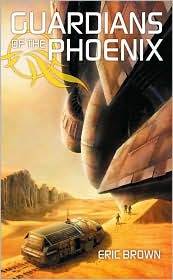
Guardians of the Phoenix by Eric Brown

Eric Brown has been writing for a while, but as far as I'm concerned he really became interesting when he published Helix about three years ago. Since then he's been turning out a surprising number of books--like six or seven so far with another due to release next month.

Helix was a strong offering: not stunning, but a good adventure story on an outlandish world--a little like Ringworld, perhaps, but without Ringworld's sense of epicness.

Necropath was very different in tone but an even better book: a solid science fiction tale blending in a murder mystery and psionic abilities. He continued the saga with Xenopath and Cosmopath and never really lost the pace, though by the end of the last I was starting to see some of Helix shining through.

I missed a few other of his releases, then picked up this one: Guardians of the Phoenix. Here Brown is definitely returning to his Helix roots: it's an adventure tale concentrating on a small group of desperate people struggling to travel to a half-mythical goal across a horrible landscape. This time, instead of placing our adventurers on a novel planet, Brown has decided to tear up the Earth: in this post-apocalyptic tale the oceans have dried up and the planet has been covered with sand dunes, with the last remnants of humanity numbering perhaps in the thousands worldwide.

Brown pulls several things off well in this story. The environment is well crafted: not as stifling and fraternal as Glen Cook's Passage At Arms perhaps, but still enough to make you feel adrift on that barren wasteland. The reveals are thin but well timed--sometimes you can feel he's dragging them out on purpose, but he never seems to be stuffing pointless material in there for pacing. And while the characters have annoying traits, you can at least identify with them.

And naturally there are things I'd like to see improved. There are too many scene shifts early in the book: with only 450 pages this doesn't qualify as even Medium on my tome-o-meter, so I don't want to see six or seven different viewpoints in the first six or seven chapters. It's a relatively small group of people, so let me get to know them a little, eh? One of those viewpoints is awkward as well--it's backstory for a character who doesn't appear in the flesh until the last chapter, and each bit of backstory is only a page or two. I understand why Brown needed to add this stuff, but it could've been managed better.

I don't think we'll be seeing a sequel to this one; it wouldn't fit well on the ending, as any follow-up would have too many new characters and a new location. But it was a worthwhile read anyway.

Sunday, February 13, 2011

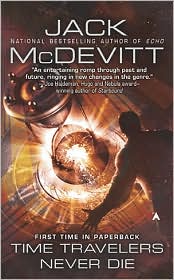
Time Travelers Never Die by Jack McDevitt

Before I write this, I have to disclose a little personal bias: Jack McDevitt is one of the best science fiction authors writing today. He has produced a diverse collection of works, most of which are simply phenomenal. I buy every book he writes as soon as I notice it has become available. His The Engines of God was one of the best SF books I've ever read.

So keep that praise in mind while I tell you that this book sucked. The only thing going for it was McDevitt's healthy experience as an author: the book was mechanically well done with a story line that was (despite the time travelling confusions) always nicely consistent and well paced.

What it lacked was, oh, most of everything else. I read this book two weeks ago, and at the moment I can't remember the MC's name nor that of his time-travelling friend. The characters were simply boring despite the handy dandy time travelling devices they played with. The book was also, surprisingly, almost entirely lacking in plot: three quarters of the book consisted of a hunt for one person or another (the dad, then the friend, then the MC) in various times--but it never felt urgent or exciting at all. Halfway through the book I was still waiting for a real problem to appear, and it never really did.

Curiously, this is not the first time McDevitt tried his hand at a time travel novel. His other one, Ancient Shores, was even worse than this one--a real stinker of a book that was so bad I wondered at the time if McDevitt signed his name on someone else's work.

Stay away from Time Travelers Never Die. But honestly, don't hesitate to pick up anything else with McDevitt's name on it; most of his tales are excellent.

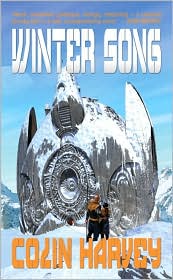
Winter Song by Colin Harvey

I really enjoyed this book for the first few chapters. It was delightful: spaceships and nanotech, FTL weapons, a desperate escape using some nifty technology and the prospect of a survival story on an iceball of a planet. I positively devoured this thing. At the beginning.

Our hero manages to flee to the promised frozen wasteland and is rescued and brought to a local village to be brought back to health. But as he convalesces, the story starts to fall apart--not because the MC has developed multiple-personality disorder (because his ship shoved its AI into his brain as part of his escape attempt), but because one of his personalities is written in the first person, and everything else is written in third.

I was channeling KC every time the first-person/third-person shift happened: this little voice would start repeating, "I can't believe the author just did that! Really, is this really going to continue through the whole book? Really?" The shift was horrifically jarring, throwing me straight out of the book and dreading when the next instance would occur.

The author also kind of wimps out over the course of the book. At the beginning it's all violence and no pity; he kills a cute little puppy for crying out loud--and not even as a random brutality, but rather targeting a puppy that was introduced several chapters before and had been popping in and out ever since. Cruel but reasonable with the background: think frozen planet, desperate people, hard circumstances. There's a crazy guy eating vomit because he's desperate for calories. It's harsh, but you agree it probably should be.

But by the end of the story, we're all friends. The bad-guys-in-space, after having taken out our MC's ship, have blown each other up and disappeared from the story in a cloud of debris. The bad-guys-on-the-planet have agreed that it's all for the best if we just stop fighting and chasing each other. Even the vicious wampa-like indigenous creatures that everyone on the planet fears have proven to be neither vicious nor indigenous, but rather intelligent and capable of enjoying theoretical discourse. Where did all the anger go?

Anyway, I'll provide a B&N Link, but I can't really recommend that you bother following it.

Wednesday, December 15, 2010

Feed by M.T.Anderson

I hate spoilers, but I can't really review this properly without one this time. So be forewarned.

Feed is set many hundreds of years from now in a dystopia that evolved from allowing our free markets and conglomerates unfettered reign. The forests have been pulled down, the oceans poisoned, and the weakened atmosphere has let background radiation grow so high that it's only through technology that we can continue to have healthy children. That same technology is our constant companion now, embedded as a Feed in our heads and force-feeding us a constant stream of marketing and information.

"I don't know when they first had feeds. Like maybe, fifty or a hundred years ago. Before that, they had to use their hands and their eyes. Computers were all outside the body. They carried them around outside of them, in their hands, like if you carried your lungs in a briefcase and opened it to breathe."

The premise of a world where computation is naturally equated with breathing is fascinating. And Anderson does a great job of conveying the personalities of his characters--which is actually unfortunate because they're all intentionally shallow, ignorant and flighty, shifting their opinions to follow every hint from their peers. Never having needed to memorize or learn--after all, instant data access 24/7 in your head, yeah?--the characters are terrible at communicating: nearly every sentence they speak (aloud or in chat) involves nouns replaced by "thing" followed by a few curse words while a lookup is done.

"Marty said, 'It will be a, a, you know, funckin', it will...' He kind of waggled his hand."
"Look at the guy in the, you know, that thing? The neck bat?" ... "Bow tie."

It's a captivating world, reminding me not a little of Barnes' Orbital Resonance (a great book btw). But--and here we're getting into spoiler territory--the MC is a total shit head.

See, a few pages into this book our group of friends--the MC Titus and his buddies, plus a new girl Violet whom they just met--has their feeds hacked. They're offline for several days while they get the virus cleaned out, but Violet's feed is physically damaged and she spends the rest of the book dying: the feed is implanted in the brain, integral to its function, and hers is shutting down. And the worse she gets, the more Titus pulls away from her--revealing in painful detail exactly what a shallow asshole he really is.

I like books with happy endings, and I really like books where I can identify with the characters; couldn't enjoy either of those here. But Feed was so compelling that I have to give it a thumbs-up anyway.

B&N link

Tuesday, October 19, 2010

Plague Year by Jeff Carlson

I have to be a little careful here, since I'm planning to send this one to my mother to read--and she's reading this blog. So no spoilers allowed, or at least none that count.

Plague Year is a post-apocalyptic yarn: a medical nano, designed to eat cancer cells and reproduce in a Von Neumann-like way, has escaped into the open and started chewing its way through humanity. When the story opens the only people left alive are the ones who managed to make it to safety above ten thousand feet (the nano shuts down at 0.7 atmospheres of pressure as a built-in failsafe).

That includes our intrepid clan of a dozen heroes and anti-heroes, stuck on a barren mountaintop at the edge of California. There's another small group within signalling distance, but they can't even visit because just one breath taken in the valley between would infect any explorer--and it's hard to climb back out when you're being eaten alive. Yum.

Did I mention the mountaintop is barren? Mammals are going extinct everywhere; our heroes are eating moss and lichen to survive--and each other. "They ate Jorgensen first", the book explains at the outset. "He'd twisted his leg bad--his long white leg." In fact, when someone from the other mountaintop stumbles bleeding and dying into their camp, the first thing they think is, "if he dies we'll eat him," and when he says he wants them to visit, they wonder if it's really a hidden hunting trip.

The book isn't really gruesome, but the author definitely plays this setup for effect. And he does a good job with it--but about halfway through the book sags badly because of some political dragging that never really goes away thereafter. (In all honesty, I skipped about fifteen pages just to get back to where Things Were Happening, and I'm glad I did; I don't think anything important happened in there.) After reading the fairly predictable ending I was fairly surprised to hear there are two more sequels coming, but I'll probably pick up at least the first of those to see what happens.

Tuesday, September 28, 2010

Star Smashers of the Galaxy Rangers by Harry Harrison


I read a lot of Harry Harrison's books when I was younger, but I hadn't read one in years when I heard about Star Smashers of the Galaxy Rangers. I bought it without having the least idea what it was about.

Here's the first sentence, and if you don't wring your hands and grin with glee, you've either never read Harry Harrison or you've never read any of the bad SF books he's parodying: "'Come on, Jerry,' Chuck called out cheerfully from inside the rude shed that the two chums had fixed up as a simple laboratory."

Harry Harrison is a very funny writer, and he's dead-on with his imitation of bad SF. The story follows Jerry and Chuck, their friend Sally, and the mysterious John as they accidentally invent an ultra-powerful substance they call cheddite (because it's made from cheddar cheese) and use it to travel the galaxy. The story is hilariously illogical and full of long paragraphs of beautifully written balonium. By the end of the book, every time I saw the word 'ravening,' I had to giggle uncontrollably.

My main problem with the book is its length. By about halfway through, the whole parody thing started to feel old. I wonder if Harrison might have felt the same way, because about the time I caught myself getting bored with the joke, the story began to feel like less of a parody and more like a real Harry Harrison book: witty, inventive, fast-paced, and unexpected.

This book was first published in 1973. Some of the slang is outdated, but in a weird way that just adds an extra layer of funniness to the parody.

B&N link

Thursday, September 16, 2010

Snake Agent by Liz Williams

Snake Agent is a marvelous blend of science fiction, fantasy, and horror, a very different book with an intricate, solid plot. I don't know why someone didn't tell me about Liz Williams before now.

Actually, I've had this book for over a year, languishing in my To Be Read pile because of its thickness (I'm not fond of very long books) and the unattractive cover. I picked it up mostly because I'd been looking for a meaty urban fantasy but couldn't find one. This was far better than anything I had expected.

Detective Inspector Chen is an investigator of the supernatural as part of his job in the Singapore Three police department. When a woman asks for help finding the soul of her murdered daughter, who should have arrived in heaven but instead ended up in hell, Chen starts an investigation that uncovers a conspiracy between corrupt humans and one of hell's most powerful ministries. At the same time, Seneschal Zhu Irzh, a demon in hell's Ministry of Vice, is sent to investigate the appearance in hell of innocent souls--young women who were supposed to go to heaven but ended up in the brothels of hell without the proper paperwork.

This would be only slightly interesting to me if the heaven and hell were those from the Judeo-Christian mythos. Instead, the setting is a mixture of Chinese legend and science fiction/fantasy invention. It's fresh and exciting, endlessly fascinating. There's much more to the book than the main plot, too. Chen's wife has an important role--so much so that I'm afraid to say anything about it for fear of spoiling something.

Liz Williams handles viewpoint shifts with a masterful touch--ordinarily I really hate books with multiple points of view (which is such a bugbear with me that I actually try not to let it influence my reviews), but it worked so well in this book that I barely noticed.

The writing is descriptive and lovely, the characterization deft. Williams is able to define a fully realized character with one perfect line of dialogue. And the worldbuilding is astounding. In fact, in terms of characterization and worldbuilding, I'd rank Williams right up with Sarah Monette and Scott Lynch. Like both those authors, her writing is layered and nuanced without becoming unwieldy. I have no idea why she isn't more popular--or maybe she is and I'm just the last person on earth to read her.

B&N link

Thursday, September 2, 2010

Stone Spring by Stephen Baxter

Stephen Baxter, imho, is the science fiction master of big-and-little, and a master of vivid world-building. His characters are mostly interesting, sometimes fascinating, and his plots are wonderful--'Riding...superstrings to the edge of the Universe!' Cities less than a centimeter tall, in the heart of burned-out suns! Life on Titan!

I'm used to grabbing everything he writes (and he writes quickly, good juicy long books that often turn into a series), so when he came out with Stone Spring, Book 1 of 3 about England's Mesolithic Period (~10,000 B.C.), I immediately ordered it from England, since it's not yet available in the U.S.

I should have saved myself the trouble.

The premise of Stone Spring is simple: global warming is melting the northern ice, which results in tsunamis inundating England's old coastlines. A former slave from Jericho (where, according to the Bible, there was a battle that brought Jericho's walls down), who knows how to build bricks, builds a big wall to keep out floodwaters.

End of story. Big deal

I got to page 200 and quit. The plot was snoringly easy to figure out, and I had 300 pages to go. I didn't like any of the characters, who mostly grunted, stank of fish, and raped or got raped. Let them all drown, I thought. Who cares?

I'm not going to buy Books two and three unless the reviews say that Baxter drops aliens out of the sky or sends a giant comet full of viruses down onto his little group of boring savages. Maybe I'll just find another Killer B in the science fiction section...(so far, I include Greg Bear, Gregory Benford, Baxter and David Brin...)

Or I'll leap to the C's.

Powell's link

Wednesday, August 25, 2010

Mockingjay by Suzanne Collins

Suzanne Collins wrote a book, The Hunger Games, about young people being chosen by lottery to fight each other to the death as a form of entertainment and governmental intimidation. It was fast-paced and surprising, and offered a grim survival plot that was intriguing and simply written, and the book was so popular it even got into book review clubs for little old ladies like me.

Book Two, Catching Fire, featured lots more killing and maiming and the beginnings of revolution.

Mockingjay pulls it all together, and the reader gets more fighting and maiming and bombings, and the revolution.

I found it amazingly dull.

The author was clearly obsessed with her clever heroine, but I could never see Katniss--she was just an avatar in a cool costume, always stalking, loading her bow with explosive arrows, being brave, being smarter and more charismatic than anyone else. Prettier. The best climber. The most spunky.

By the third book I didn't care what she did or how cleverly she did it--I could assume she'd wind up with her star-crossed (and often wounded) lover; that the post-apocalypse world would, due to her brains and battle skills, carry on with fewer people but with the villains dead.

I'll admit it: I skimmed the book's second half. And I read ahead--saw what happened twenty years later.

I'd guessed correctly.

Snore.

I can recommend Hunger Games, Book One, for its pure shock value and intricate plotting. Read Book One, and just know (spoiler) that cleverness wins over evil by page 1000-something.

Tomorrow I'm donating Mockingjay to the local library to complete their trilogy.

And: I'm starting Stephen Baxter's newest SF trilogy about the earth in 7900 bc in old, old England.

B&N link

Tuesday, July 27, 2010

Heroes Return by Moira J. Moore

Heroes Return is the fifth book in this series, which starts with Resenting the Hero. The books have terrible covers, particularly the first two. Ignore the covers. The books themselves are quite interesting.

Despite the covers' attempts to make the series look like wacky, wacky fairy-tale fantasies, the books are much more SFnal than fantasy, or they were until the last two books when magic starts getting more attention. Briefly, this is a world beset by dangerous natural disasters--earthquakes, typhoons, erupting volcanoes--that are severe enough and common enough that they would destroy civilization if it weren't for Sources and Shields. Sources are people with the ability to channel natural disasters and dissipate them harmlessly, while Shields keep the Sources from being ripped apart in the process. Sources and Shields work best when bonded for life.

It's a fascinating concept, and the main reason why I keep reading. The books follow Shield Dunleavy Mallorough--Lee--and her Source, Shintaro Karish, known as Taro. Lee is the calm one of the duo, while Taro is often fretful and emotional. In fact, since Shields tend to have slightly dulled senses and placid demeanors, Lee makes for an interesting main character. I can never really be sure if her inability to notice bad guys acting blatantly is a result of her character--in which case Moore is a brilliant writer--or if it's just clumsy characterization. I go back and forth on it. It's certainly frustrating. I do long for the day when Lee stops just thinking those snappish thoughts and actually starts speaking her mind--please--or hopefully just hauls off and slugs some irritating character in the face.

A lot of the characters in these books are irritating, abrasive, or just plain hateful. I like Lee and Taro (although so much of their issues could be cleared up if only they'd have a meaningful discussion instead of Lee being silent and Taro jumping to conclusions), but I rarely like anyone else. And yet I snap up the next book as soon as it's available--I snagged this one early and have set up this review to run (hopefully) on July 27 when it's officially released--and drop everything else to read it immediately.

Heroes Return is an excellent addition to the series. Lee and Taro have been posted to Taro's distant boyhood home, home to his poisonous mother, the Dowager Duchess. Taro has renounced his title and passed it on to a cousin, but his mother seems convinced she can make him change his mind. This unsettles Lee, who worries about Taro and who really doesn't want to spend the rest of her life in the middle of nowhere too. Not only that, but the Emperor seems convinced that the townsfolk and farmers of the area are working magic illegally and sends his agents to root out and punish practitioners, someone seems to be trying to kill Lee, and Lee and Taro are having trouble channeling the region's earthquakes properly. Unlike several of the previous books, this one kept me guessing about what was really going on. The relationship between Lee and Taro is as usual both sweet and maddening.

The books can be read out of order, but you'll run across a lot of spoilers that way. I recommend the whole series, though.

B&N link

Tuesday, May 4, 2010

The Survivor trilogy by Susan Beth Pfeffer

The moon gets hit by an asteroid and then goes into a closer orbit around the earth, and whiny teenagers everywhere are about to find out that life isn’t about finding a prom dress, and that a nice supper might involve a two-year-old can of Popeye spinach and some dog food.

That’s the premise of the trilogy written by Susan Beth Pfeffer for nervous young people.

We meet Whiny Teenager number one, Miranda, in Pfeffer’s first moon book, Life As We Knew It.

Miranda keeps a diary, and she is as shallow as a puddle. I thought after page 100 or so, by which time the moon’s closer orbit had already caused lots of trouble (volcanic ash, earthquakes, etc.), Miranda would quit running off to her bedroom and slamming the door because mean old Mom kept hurting her feelings.

But I hung in there, because I found the plot fascinating: Just what is a girl to do when she runs out of lipstick and she can’t wash her hair because there’s no shampoo or running water?

Miranda takes a very long time to wise up. She worries about her brother Matt being the favorite, even as her friends die or get robbed.

I was happy to see that Pfeffer started off volume two with a new protagonist, Alex, who went through the same moon trauma in a New York City apartment.

Alex was a bit anal and never whined. He was driven to be perfect. He liked knowing rules so he knew where he stood.

With Alex, Pfeffer hits her stride. He learns quickly that to survive in New York City and to provide for his sisters, he’ll have to pull shoes off corpses and barter for boxes of rice. Alex doesn’t loll about in his family sunroom and vent to his diary--he grapples.

Book three, This Life We Live, brings Alex and Miranda together, which is rather clever of Pfeffer, but we’re back to diary-writer Miranda taking over the point-of-view, so Alex becomes more controlling and difficult, pushy and obnoxious as seen through Miranda’s hard-to-please eyes. They inevitably fall in love, being in close proximity for days and weeks and being full of hormones, but first, obligatorily, they have to find each other irritating for many chapters.

There’s very little information about the moon once it does its thing in chapter one of volumes one and two, and I found this frustrating. Clearly, Pfeffer did some research or made some good guesses about the results of a changed moon orbit, but she kept communication with the characters’ outside worlds limited, so that basically they were clueless about what was happening (“Why is it so cold in August? Why is it snowing gray snow?”) and, more baffling, none of the young people particularly wanted to know what was going on around the planet. Some of them even refused to be given information, which might have made it easier for the writer but was frustrating for the reader.

And there were questions I simply couldn’t answer, and Pfeffer gave me no help: Where were all these canned goods coming from? Were there new canneries? Nope--no sunshine, what with all those volcanoes erupting and hence, no photosynthesis--and who would go to work at a cannery anyway, when money was useless? So, when the cans ran out or expired, what next in a non-sunshine world? Duh: no book four, fer sure...

(Pfeffer used as a plot point some secret “safe towns,” where apparently every problem was solved--there was plenty of gasoline, trucks pulled in weekly with groceries, there were hospitals and schools!--but only people under 18 could get passes, and the passes were for the rich and powerful only. And surely Pfeffer knows that even the richest and most powerful can’t have green veggies if there aren’t any.)

There are lots of holes in her plot, but I found the story arc tight and interesting, and (even though I knew she would make her whiners grow up) she did adequately demonstrate that appalling circumstances tend to make even shallow people mature--or die off.

One thing I learned about myself from pondering this plot: If the moon changes orbit, I’m going to shoot myself before somebody steals my shoes.

I’m no grappler. Like Miranda, I'd be whining, and writing long, self-pitying diary entries.

B&N link

Sunday, March 7, 2010

How to Ditch Your Fairy by Justine Larbalestier

I picked this one up because of the title and the cover, and because the main idea seemed interesting. In the book's world, almost everyone has what they call a fairy--although no one's ever seen a fairy. Some people have a finding-loose-change fairy, or a never-getting-lost fairy. Main character Charlie (short for Charlotte) has a parking fairy, which means any car she's in will always get a great parking space. Charlie, who is fourteen, is sick of being borrowed by family members and friends when they're going somewhere. At the book's opening, she's been walking everywhere for two months in an attempt to starve her fairy out and get a new one.

That's a great concept, but it's what Larbalestier does with it that makes this book fantastic. Charlie has problems beyond her fairy: she loves basketball, but she blew the team tryouts; she's got more than just a crush on her new neighbor, Stefan, but she's not sure where she stands with him; and, of course, walking everywhere has made her late for class often enough that she's racking up demerits. She's desperate enough to get rid of her fairy even if it means asking for help from her arch-enemy, Fiorenze, a girl who has an all-the-boys-like-you fairy.

Charlie is tough but likable, funny without being snarky. The worldbuilding is excellent too--I thought this would be a fantasy, but it's far more science fictional. Charlie is a first year student at a sports school in what seems to be a city-state called Avalon; people in Avalon are so wrapped up in their city that they scarcely know (or care) anything about other cities. This combined with the strict rules of Charlie's school--ten hour school days, six days a week--give the book a slightly oppressive feel. It works with the story, though.

I've never read a book quite like this one. I'm not doing it a bit of justice with this review. I highly recommend How to Ditch Your Fairy.

B&N link

Friday, January 1, 2010

Nation by Terry Pratchett

I can't remember when I read Terry Pratchett's first Discworld book, but I'm pretty sure it was the end of the 1980s. I had to order it specially, since back then his books weren't available in the U.S. I've read just about everything else he's written since then.

So I feel pretty confident when I say that Nation is his finest book, the one he'll be best remembered for in a hundred years.

Nation is set in a world only subtly different from ours. It starts off with two separate calamities: a plague decimating Europe's population--even the king has succumbed--and a tsunami on the other side of the world that destroys the island village known as the Nation. Only one member of the Nation survives: Mau, who was traveling back from his month-long exile on the Boys' Island to the main island, looking forward to nothing more earthshaking than his initiation as a man. He'll get a feast and a tattoo and everything.

Instead, his entire world is swept away in minutes, leaving nothing but bodies and destruction--and a wrecked ship where the only survivor turns out to be a girl named Erminrude, although she much prefers the name Daphne. Together Mau and Daphne work to reclaim a Nation of their own, dealing with refugees from other islands, their own fears and expectations, and the threat of the cannibalistic Raiders.

The real magic of this book is how the two main characters deal with their losses. Mau turns his grief into rage at the gods, questioning whether they exist--and if they do, how they could have let the wave happen. He's poised between boyhood and manhood, which he likens to being a hermit crab who's shed its old shell and is looking for a new one; he's vulnerable while he searches, but the more he looks, the more he realizes there is no shell to protect him. Daphne bore her grief many years ago when her mother and infant brother died; she's more prepared to deal with this new loss, particularly with the hope of her father coming to rescue her, but she's ill-equipped to deal with realities that her grandmother has sheltered her from all her life--like helping a woman give birth, learning how to brew beer from a poisonous plant, and supporting Mau as chief of the tiny new Nation.

Pratchett's writing is clean and confident. The story is riveting, often poignant, sometimes funny, and moves very quickly for a book that explores such weighty topics as religion and civilization. I found it thoroughly satisfying, and I loved the secret Daphne and Mau discover on the island. If I'd known how good this book was, I'd have bought it the minute it was released in hardback instead of waiting for the paperback.

B&N link