Showing posts with label reviews by Lertulo. Show all posts

Thursday, May 26, 2011

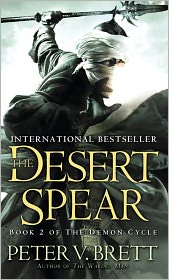
The Desert Spear by Peter V. Brett

It's a little odd to be reviewing this book without linking to my review of its predecessor The Warded Man (printed as The Painted Man outside the US). But I can't find that prior review, so maybe I simply imagined it.

Remembering how much I enjoyed reading The Warded Man, it's hard to believe I wouldn't have written a review of it. Strange. I guess I'll have to cover both this time.

This is an epic fantasy series that is thankfully entirely devoid of elves, zombies and vampires. Brett instead posits a world where mankind is a dwindling species, largely clustered inside fortified towns and villages against a demonic horde that coalesces out of the mist each night at sundown and vanishes again every morning at dawn. (Well okay, that sounds a little weak when I lay it out flat like that, but trust me: Brett manages to present that premise as a cold, hard, compelling reality.)

These corelings are largely mindless, but vicious and powerful. Most are elemental in nature: sand demons that are impossible to see in the dunes and are covered in overlapping armored plates, wood demons bristling with limbs and jagged teeth, fire demons that flicker and spit flame. Their numbers seem endless, and the world of men is dwindling in the face of their infinite onslaught.

But there is still some hope in the form of wards: drawings of a particular shape--some simple and some intricate--that can keep the demons at bay. There are only a few of these wards known now to men and these are painted or chiseled into doorposts or roadway markers by skilled craftsmen, providing some safety against the weaker demons.

But that safety isn't enough for Arlen Bales, who longs to travel outside these boundaries as a messenger--one of the elite men who can paint their own wards and keep themselves safe at night as they travel the yawning distances between safe-havens. The Warded Man follows Arlen as he learns his chosen trade--and as he eventually stumbles on a forgotten trove of ancient wards. Wards that do more than keep demons away--that can protect and kill.

This whole premise is deliciously novel--a welcome relief from a long line of LOTR wannabes. Plus, Brett proves to be a capable character builder and a superb world builder. The result is a series that's hard to put down. I think I read The Warded Man in the span of two sittings, and its sequel over the course of three days.

I did have some trouble with the architecture of The Desert Spear. In an interview in the back Brett describes his writing process, which involves planning out every scene in the book long before the words come out--which means there's really no excuse for those architectural issues either.

First, Arlen (the Warded Man himself) is obviously the hero in the first book; the author follows that character exclusively throughout his travels, watching as he visits cities in far-off lands and learns the skills he needs to fight the demons. And so a reader would naturally expect that the sequel--placed in the same world at the same time--would follow him too. But it doesn't: Arlen in truth doesn't appear until halfway through, and thereafter he's on stage only about a third of the time. The new main character is Jardir, who was a bit player in the first book--and an interesting one, sure, but not who I wanted to read about. Certainly not at such length.

Second, the first third of the book--and only the first third--intermingles current events in Jardir's life and the back-story that got him where he is now. But it does so in a very clumsy fashion, leaving the reader in the past for several chapters running, then seamlessly presenting one chapter from the present (with exactly the same characters, only now fifteen years older), then jumping right back into the past. I frequently had to puzzle out whether the younger characters were simply acting strangely, or whether we were suddenly reading about the older characters for a short time.

Those are pretty minor problems, though, in what is otherwise shaping up to be an excellent series. Brett promises a five-book series, and apparently there is a movie in the works--something I would simply love to see.

Monday, May 16, 2011

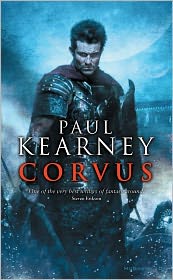
Corvus by Paul Kearney

Corvus is the sequel to The Ten Thousand, Kearney's masterful novel describing old-school warfare. Corvus picks up with the same main character Rictus, now a decade older and hoping to retire. A new, brilliant commander has arisen and presses Rictus into service as a general; together, they try to unify the entire people of the Macht.

Like its predecessor, Corvus manages to show us battles writ both large and small. Kearney goes to pains to present a wide campaign, conquering this city and bypassing that, considering entire legions as mere playing pieces in a grand game--some to be retained, some to be sacrificed. But where he really shines is in the intimate details of the spear phalanx, leaving the reader feeling muddied and wounded and pressed on all sides in the grip of othismos--the very marrow of war. These battle scenes are utterly gripping, managing to be both gruesome in detail and yet impersonal in intent as the phalanx presses the leading ranks from behind, lifting the leading elements off their feet such that the men literally walk on the dying bodies of their enemies. Kearney's descriptions show us warfare that is both vicious and uncaring--and he does it in the context of a novel that also carries realistic characters, a rich world setting and a compelling plot.

The one area where Corvus does not manage to match The Ten Thousand is in plot twists. In its predecessor, important characters are suddenly lost and battles shift unexpectedly, emphasizing the unknowable truth of a mercenary's life; in Corvus, the plot arc could be guessed by reading the summary on the back and maybe a few key paragraphs, and it never really deviates from that arc. It's a good arc, to be sure, but it's too predictable to really match The Ten Thousand for intensity.

Saturday, February 19, 2011

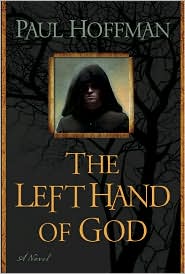
The Left Hand of God by Paul Hoffman

This was a much better book than I had expected. If I had bothered to read the first page before putting it on my to-be-read shelf, it wouldn't have sat there gathering unmerited dust for so long.

The author's phrasing gives away immediately that he isn't just putting out another also-ran fantasy book: there's no pretension, no trying to fit in with the pack. It reads very much as if someone were telling us a story while we sat around a campfire, breathless and impatient for the next detail.

The book is compelling--especially in the beginning--because of the particular cruel and horrific circumstance in which we find our main character, a boy in his early teens being raised among hundreds of others in a religious order. The zealots who run the place offer no apologies for their treatment of their charges, and that treatment is terrible to behold. It's impossible not to admire anyone who survives this place, much less those who rebel and eventually escape. And just so, the reader finds himself already a quarter of the way through the book and very much immersed by the time the plot is really unfolding.

Hoffman can't maintain that grip quite so well once the MC and his friends have started exploring the wider world outside, but before the book begins to labor the plot--rather than just the environment and back story--becomes strong enough to carry the load, with a few stumbles but also a fair share of excellent twists and turns including an unanticipated ending that definitely merits a sequel or two. The Left Hand of God has turned out to be a great start for a truly epic fantasy series.

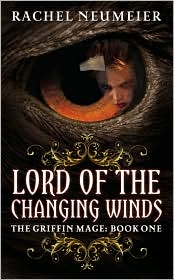
Lord of the Changing Winds by Rachel Neumeier

Griffins. I'm ready to swear that I've read this book before, except last time--um, twenty years ago or so?--it was about dragons, and this time it's griffins. For the life of me, I cannot remember which predecessor kept tugging at me as I read this one. Oh well.

Our hero Kes is an autistic waif of a girl. Well, actually, I'll let the author tell it: "She has some skill with herbs, and she can stitch a cut or set a bone. A man came and asked her to come, and she went up into the desert to help somebody who'd been hurt. Before we even knew there was a desert."

...which choice launches us nicely into the plot--and gratifyingly, that happens in the first chapter so things start moving pretty quickly. There's a shift to a second set of characters in the second chapter, and though that one's a bit of a snoozer we're back with Kes in chapter three and the alternation is established. That third chapter picks up the pace again and thereafter there's always a battle or some other appropriate tension in play. The plot is well accomplished if not particularly twisty, and the griffins themselves bring a refreshing mindset to the field.

The author has, though, done herself a disservice by choosing a shy, tentative girl as the MC; she keeps that identity a little too long and the MC gets a little mired in self-pitying whining from time to time. Ultimately she does show the inevitable character growth everyone had expected, but when all is said and done the MC has not become a strong personality (the obvious choice for growth), but rather an aloof one. That particular progression rang a little hollow; who wants an aloof main character?

In all I found the author pulled off a good balance with this book: the characters were distinctive without being too stereotypical, the environment was conveyed well (desert scenes play strongly here) and after that one misstep with chapter two the pacing never really sagged. The last of the plot pieces ended satisfyingly, leaving enough unsaid to lay the foundation for a sequel. I didn't find anything in here particularly compelling--which is to say it's not of the same caliber as such books as The Name of the Wind or The Blade Itself--but it's a fine first offering and I'm pleased to see there's a whole trilogy waiting.

Thursday, February 17, 2011

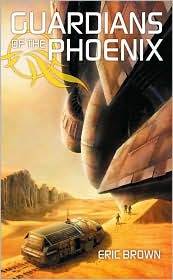
Guardians of the Phoenix by Eric Brown

Eric Brown has been writing for a while, but as far as I'm concerned he really became interesting when he published Helix about three years ago. Since then he's been turning out a surprising number of books--like six or seven so far with another due to release next month.

Helix was a strong offering: not stunning, but a good adventure story on an outlandish world--a little like Ringworld, perhaps, but without Ringworld's sense of epicness.

Necropath was very different in tone but an even better book: a solid science fiction tale blending in a murder mystery and psionic abilities. He continued the saga with Xenopath and Cosmopath and never really lost the pace, though by the end of the last I was starting to see some of Helix shining through.

I missed a few other of his releases, then picked up this one: Guardians of the Phoenix. Here Brown is definitely returning to his Helix roots: it's an adventure tale concentrating on a small group of desperate people struggling to travel to a half-mythical goal across a horrible landscape. This time, instead of placing our adventurers on a novel planet, Brown has decided to tear up the Earth: in this post-apocalyptic tale the oceans have dried up and the planet has been covered with sand dunes, with the last remnants of humanity numbering perhaps in the thousands worldwide.

Brown pulls several things off well in this story. The environment is well crafted: not as stifling and fraternal as Glen Cook's Passage At Arms perhaps, but still enough to make you feel adrift on that barren wasteland. The reveals are thin but well timed--sometimes you can feel he's dragging them out on purpose, but he never seems to be stuffing pointless material in there for pacing. And while the characters have annoying traits, you can at least identify with them.

And naturally there are things I'd like to see improved. There are too many scene shifts early in the book: with only 450 pages this doesn't qualify as even Medium on my tome-o-meter, so I don't want to see six or seven different viewpoints in the first six or seven chapters. It's a relatively small group of people, so let me get to know them a little, eh? One of those viewpoints is awkward as well--it's backstory for a character who doesn't appear in the flesh until the last chapter, and each bit of backstory is only a page or two. I understand why Brown needed to add this stuff, but it could've been managed better.

I don't think we'll be seeing a sequel to this one; it wouldn't fit well on the ending, as any follow-up would have too many new characters and a new location. But it was a worthwhile read anyway.

Sunday, February 13, 2011

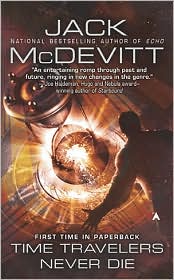
Time Travelers Never Die by Jack McDevitt

Before I write this, I have to disclose a little personal bias: Jack McDevitt is one of the best science fiction authors writing today. He has produced a diverse collection of works, most of which are simply phenomenal. I buy every book he writes as soon as I notice it has become available. His The Engines of God was one of the best SF books I've ever read.

So keep that praise in mind while I tell you that this book sucked. The only thing going for it was McDevitt's healthy experience as an author: the book was mechanically well done with a story line that was (despite the time travelling confusions) always nicely consistent and well paced.

What it lacked was, oh, most of everything else. I read this book two weeks ago, and at the moment I can't remember the MC's name nor that of his time-travelling friend. The characters were simply boring despite the handy dandy time travelling devices they played with. The book was also, surprisingly, almost entirely lacking in plot: three quarters of the book consisted of a hunt for one person or another (the dad, then the friend, then the MC) in various times--but it never felt urgent or exciting at all. Halfway through the book I was still waiting for a real problem to appear, and it never really did.

Curiously, this is not the first time McDevitt tried his hand at a time travel novel. His other one, Ancient Shores, was even worse than this one--a real stinker of a book that was so bad I wondered at the time if McDevitt signed his name on someone else's work.

Stay away from Time Travelers Never Die. But honestly, don't hesitate to pick up anything else with McDevitt's name on it; most of his tales are excellent.

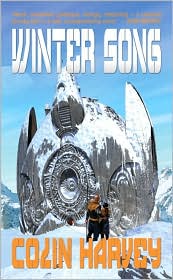
Winter Song by Colin Harvey

I really enjoyed this book for the first few chapters. It was delightful: spaceships and nanotech, FTL weapons, a desperate escape using some nifty technology and the prospect of a survival story on an iceball of a planet. I positively devoured this thing. At the beginning.

Our hero manages to flee to the promised frozen wasteland and is rescued and brought to a local village to be brought back to health. But as he convalesces, the story starts to fall apart--not because the MC has developed multiple-personality disorder (because his ship shoved its AI into his brain as part of his escape attempt), but because one of his personalities is written in the first person, and everything else is written in third.

I was channeling KC every time the first-person/third-person shift happened: this little voice would start repeating, "I can't believe the author just did that! Really, is this really going to continue through the whole book? Really?" The shift was horrifically jarring, throwing me straight out of the book and dreading when the next instance would occur.

The author also kind of wimps out over the course of the book. At the beginning it's all violence and no pity; he kills a cute little puppy for crying out loud--and not even as a random brutality, but rather targeting a puppy that was introduced several chapters before and had been popping in and out ever since. Cruel but reasonable with the background: think frozen planet, desperate people, hard circumstances. There's a crazy guy eating vomit because he's desperate for calories. It's harsh, but you agree it probably should be.

But by the end of the story, we're all friends. The bad-guys-in-space, after having taken out our MC's ship, have blown each other up and disappeared from the story in a cloud of debris. The bad-guys-on-the-planet have agreed that it's all for the best if we just stop fighting and chasing each other. Even the vicious wampa-like indigenous creatures that everyone on the planet fears have proven to be neither vicious nor indigenous, but rather intelligent and capable of enjoying theoretical discourse. Where did all the anger go?

Anyway, I'll provide a B&N Link, but I can't really recommend that you bother following it.

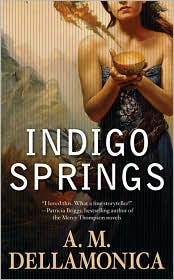
Indigo Springs by A. M. Dellamonica

I'm having trouble writing a review for this book, largely because I can't decide whether I liked it or not.

Indigo Springs has several things in its favor. The basic magical device in the story--a thick blue water-like "vitagua" that responds to human will--is both novel and richly integrated into our mythos and pseudo-history. There is a diverse cast of characters, but there are never too many to track. The book is framed in a sleepy little town that quickly and comfortably settles around you--and yet its world never really feels small. And the writing was fluid enough, with sufficiently dynamic pacing, to make me keep chewing through the chapters.

And yet, not everything is delightful in here. The main character is a whining douche, inexplicably love-struck over her self-absorbed would-be girlfriend. She lives with her half-brother who is likewise a douche. Her mother is a bad-tempered half-male weirdo. And there's an extra main character--a government agent who spends the book asking her questions and getting a long back story in response--who can't seem to decide if he should ever play a prominent role or not. (I suspect he'll show up in the inevitable sequel.) The MC's actions throughout the book are frequently--no, almost continually--unjustifiable. Is it really possible for anyone to make a bad decision every hour of every day for weeks on end? Yikes!

After weighing the pros and cons, I think I've decided that I won't be picking up the sequel. But I can't really regret having spent the time to read what was, after all, a reasonably good book.

Wednesday, December 15, 2010

Feed by M.T.Anderson

I hate spoilers, but I can't really review this properly without one this time. So be forewarned.

Feed is set many hundreds of years from now in a dystopia that evolved from allowing our free markets and conglomerates unfettered reign. The forests have been pulled down, the oceans poisoned, and the weakened atmosphere has let background radiation grow so high that it's only through technology that we can continue to have healthy children. That same technology is our constant companion now, embedded as a Feed in our heads and force-feeding us a constant stream of marketing and information.

"I don't know when they first had feeds. Like maybe, fifty or a hundred years ago. Before that, they had to use their hands and their eyes. Computers were all outside the body. They carried them around outside of them, in their hands, like if you carried your lungs in a briefcase and opened it to breathe."

The premise of a world where computation is naturally equated with breathing is fascinating. And Anderson does a great job of conveying the personalities of his characters--which is actually unfortunate because they're all intentionally shallow, ignorant and flighty, shifting their opinions to follow every hint from their peers. Never having needed to memorize or learn--after all, instant data access 24/7 in your head, yeah?--the characters are terrible at communicating: nearly every sentence they speak (aloud or in chat) involves nouns replaced by "thing" followed by a few curse words while a lookup is done.

"Marty said, 'It will be a, a, you know, funckin', it will...' He kind of waggled his hand."
"Look at the guy in the, you know, that thing? The neck bat?" ... "Bow tie."

It's a captivating world, reminding me not a little of Barnes' Orbital Resonance (a great book btw). But--and here we're getting into spoiler territory--the MC is a total shit head.

See, a few pages into this book our group of friends--the MC Titus and his buddies, plus a new girl Violet whom they just met--has their feeds hacked. They're offline for several days while they get the virus cleaned out, but Violet's feed is physically damaged and she spends the rest of the book dying: the feed is implanted in the brain, integral to its function, and hers is shutting down. And the worse she gets, the more Titus pulls away from her--revealing in painful detail exactly what a shallow asshole he really is.

I like books with happy endings, and I really like books where I can identify with the characters; couldn't enjoy either of those here. But Feed was so compelling that I have to give it a thumbs-up anyway.

B&N link

Tuesday, October 19, 2010

Plague Year by Jeff Carlson

I have to be a little careful here, since I'm planning to send this one to my mother to read--and she's reading this blog. So no spoilers allowed, or at least none that count.

Plague Year is a post-apocalyptic yarn: a medical nano, designed to eat cancer cells and reproduce in a Von Neumann-like way, has escaped into the open and started chewing its way through humanity. When the story opens the only people left alive are the ones who managed to make it to safety above ten thousand feet (the nano shuts down at 0.7 atmospheres of pressure as a built-in failsafe).

That includes our intrepid clan of a dozen heroes and anti-heroes, stuck on a barren mountaintop at the edge of California. There's another small group within signalling distance, but they can't even visit because just one breath taken in the valley between would infect any explorer--and it's hard to climb back out when you're being eaten alive. Yum.

Did I mention the mountaintop is barren? Mammals are going extinct everywhere; our heroes are eating moss and lichen to survive--and each other. "They ate Jorgensen first", the book explains at the outset. "He'd twisted his leg bad--his long white leg." In fact, when someone from the other mountaintop stumbles bleeding and dying into their camp, the first thing they think is, "if he dies we'll eat him," and when he says he wants them to visit, they wonder if it's really a hidden hunting trip.

The book isn't really gruesome, but the author definitely plays this setup for effect. And he does a good job with it--but about halfway through the book sags badly because of some political dragging that never really goes away thereafter. (In all honesty, I skipped about fifteen pages just to get back to where Things Were Happening, and I'm glad I did; I don't think anything important happened in there.) After reading the fairly predictable ending I was fairly surprised to hear there are two more sequels coming, but I'll probably pick up at least the first of those to see what happens.

The Darkest Edge of Dawn by Kelly Gay

I just re-read my review of this book's predecessor (The Better Part of Darkness) to see how the two compare. Turns out there are some things that have improved and some that haven't; big surprise there.

Kelly Gay jumps right back into the world she left--just days later in story time. Atlanta has undergone some big shifts: there's this whole cloud-of-darkness floating over the city, for example, and the level-one boss from the previous book has checked out. Taking his place is a serial murderer, and it's up to our dynamic duo of MCs to find and stop him.

This book doesn't bring in much additional novelty. We revisit the Djinn, which is fun but not really new since they were covered pretty well last time. We get to see our buddy cop the Siren pull off some big magic, but again that's been seen before. The MC's sister is addicted to a nasty magic+drug combo, but that was the result of book one's plot. OTOH, even though the world hasn't expanded much it's still rich enough to justify the additional interior exploration.

Another thing that hasn't changed much is the MC, Charlie Madigan. I'm hoping that's the result of the short story-time between books 1 and 2, rather than the author's inability (or lack of desire) to let the character grow and change. Take the Dresden series for comparison--and yes, I'm biased since I love that one: the MC there grows and changes significantly from book to book, and his compatriots grow and change with him. I really want to see some of that happening here.

That's all kind of bumming, but it's not particularly bad. The yummy part is that Gay manages to keep the light-and-fast thing going again: action interleaved with drama and plot twists, a few minor novelties thrown in just when you need them. The pacing is very good and turns this into a fun read, with a satisfying dénouement--that last bit being a welcome improvement, since the last one's epic clash was so very, very flat.

So, as with the last one, this is a fun but not really compelling book. I'll be buying book three, but if the characters don't get their growth on and the author can't expand the world into new directions, I doubt I'll read book four.

B&N link

The Magician's Apprentice by Trudi Canavan

This isn't the first of Canavan's books that I've read, but so far I like it best. Her most recent series before this--the Age of the Five--started fine but ended up awfully dry. This time she manages to keep a solid pace throughout.

You can't help but like the MC here: the daughter of a peasant/physician, skilled herself and thrust into a higher level of society unexpectedly when she suddenly shows signs of being magically gifted. She's brusque, irreverent, talented and intelligent--but Canavan manages to keep her from being too much of any of these in particular.

The setting is also lively, starting in a village on the outskirts of society, moving into the Big City, then sending us back out to the woods and eventually past the mountains into a different land. That last step seems to move a little faster than it should, taking away some of the enjoyment of visiting a new society. And the setup for the sequel is definitely likewise truncated, but not so badly that the rest of the book isn't worth reading.

The King's Bastard by Rowena Cory Daniels

I really tried hard to like this one, and I even succeeded for small portions at a time. It's not a bad book, but it had a habit of getting underneath my fingernails.

The basic foundation is good: there's your Favorite Kingdom, with its Troubled Princes, its Queen With Secrets, its Mischievous Young Princess and even (I like this part) its Associated Warrior-Monk Monastery. There's even a good bit of magic tossed in: "affinity" (whatever the hell that means) which seems to be nothing but groovy for people to get but is nonetheless considered a dirty sin. It's a good start for a book. I even liked the main characters, both good and bad: they had personalities, something my previous read lacked. So, fair points and a good start for Daniels.

The book flopped for two reasons, one of which is the author's fault and the other of which is probably just a pet peeve of mine. The former is coincidence: every single plot point in this book--every one, no exceptions--takes place because of sheer chance. Consider that by the end of the first chapter the hero has had his bowstring snap at just the wrong time, his buddy--an experienced warrior--has accidentally knocked a tree limb onto himself during a back-swing, and has thereby almost killed himself. Conversations are overheard at just the right or wrong time, people happen to arrive just as someone else is leaving, the important note happens to be on the table as someone walks in. Again, and again, and again. It's okay to let a few of these creep in, but at some point an important thing has to occur because a hero made it inevitable, not because the gods are playing tricks.

Okay, bad as that was, it doesn't make this book a deal-breaker; after all, the writing is reasonably good (nice descriptions in particular) and the foundation was, as I said, solid. What I can't forgive is that the major intricacies that make up the book's plot all relate to misunderstandings. Every character, again no exceptions, makes decisions based on what information they have to hide from others, or have incorrectly gleaned from others, in an elaborate game. A thinks (correctly) that B is gay (important plot point, actually); C tries to shield B so A and D both think C is gay too, which he's not. But no one will listen, and C can't clear his name without throwing B to the wolves. Meanwhile, E doesn't trust B because of what D said, and B can't clear his name without F talking--and neither A nor E will talk to F. Yuck.

In chapter after chapter, I kept getting the feeling that these people were all idiots. If they would just sit down together, talk frankly and listen to each other, there would have been no plot left at all. It's a little like an awkward holiday at the homestead: one aunt isn't talking to another aunt, and no one wants to talk about why. Elephants. Room. Annoying.

I hate books that turn out this way. Almost all the conflict in this book--not all (there are indeed invading armies) but almost all--is derived from misunderstandings and mistrust. It makes the whole book feel terribly contrived: nothing bad would've happened if the characters (a) hadn't had some horrible accident or (b) they had just explained what happened and everyone listened.

I got a copy of this book for review (thanks, KC!) and have since seen it on the BN shelves next to its sequels. I almost--almost--picked up one of those, but for all its good points I just couldn't subject myself to more of this horrible plot mechanic.

(Quick edit from KC to add that this book was sent us by the author for review.)

B&N link

The Edge of the World by Kevin J Anderson

In Starship Troopers, Heinlein (through the voice of a high school teacher) explains that value is subjective and mutable: a good chef can take apples and dough and form a delectable pastry that's worth more than its parts, while an incompetent chef can make these ingredients--already wholesome and valuable in themselves--into an inedible, worthless mess.

The Edge of the World is part one of what should have been an impressive high fantasy saga: after all, it has the right ingredients. Anderson is a talented, first-rate writer with a great track record--dozens of published books, many of which I've enjoyed greatly. He has obviously done his homework here, putting in a lot of effort to build an elaborate world to play in: a religious mythos that forms the basis for his major peoples, multiple societies, characters from all over the world. The environment is well chosen, letting the author play with lots of exploration (ships, hot air balloons, overland treks) and novelties (interesting magics, the invention of gunpowder, unusual sea creatures). And the plot is well designed: the story arc (and primary characters) follow the map of the main religion, rediscovering artifacts and searching for ancient continents. How on Earth could all this go wrong?

I'll tell you how: not with a bang does this fail, but with a snore. Halfway through this first book I was completely bored with it, and trudged through only by sheer determination. I even bought the sequel just to prove that I was willing to give Anderson a fair shake, but a quarter of the way through I put it down and never picked it back up.

Ultimately this book lost me because it left me unable to identify with a single one of its main characters. They all had the exact same character flaw: when in desperate trouble, they did...nothing. The hero of an early exploration whose ship was destroyed and who rode home on a sea monster then walked into the mountains for twenty years to herd sheep. His pregnant young wife, who was abducted by a foreign war party and made queen, just sighed and acquiesced. The king who should have set his world on fire to explore and conquer, did practically nothing except grow old and tired and eventually die. Yawn. The only character in the book who was remotely interesting was a madman--but in such a big novel, he was lost in the noise.

Hint to Anderson: next time, make your characters exciting.

B&N link

Dying Bites by D D Barant

Yet another urban fantasy series. I'd really love to say this one stood out in some fashion from the genre, but the truth is it doesn't. From its cookie-cutter MC to its snarky, double-entendre title it's pretty much a carbon copy of everything on the UF shelf that you've already read.

Let's start with that MC--and I can't do it any better than the book does itself:

"I get my share of male attention. I stand five eight, do a hundred crunches a day and have the abs to prove it. I've been told I have the neckline of a goddess, though nobody ever says which one. My hair is long, very black, and full, while my features tend more toward the Slavic definition of beauty than North American. I don't put on a miniskirt unless I mean it, but when I do I can cause car accidents."

Mary Sue, any one? MC is tough as nails, carries an oversized gun (page 3: "It's a Ruger Super Redhawk Alaskan, a short-barreled revolver chambered with .454 ammunition..."), enough martial arts to handle a werewolf in full attack mode... you get the drift.

Pretty bad so far. The only thing that remotely makes this series different from its peers is its setting: the first pages introduce the MC being slipped from our universe through a dimensional gateway to a parallel one, and in this new place humans are a small government-protected minority of the population (rough thirds being vampire, were and golem--that last at least an interesting addition). And the only part of the plot that's worthwhile is that the MC is chasing a serial killer, and it's at least mildly interesting to try to figure out what's happening before the characters do.

The book culminates in a Deus Ex Machina ending, nearly literally, that comes through as a horrific blunt trauma to the reader's suspension of disbelief. It's clear that the author wants to set up a sequel--and in fact, one's available--but I have no idea why any reader would bother.


B&N link

Tuesday, May 11, 2010

Gardens of the Moon by Steven Erikson

Five hundred heavy pages of epic fantasy, and there are no less than ten books in the series--eight already printed, two more forthcoming. I suppose it was inevitable that sooner or later I'd come across this one. Frankly I'm surprised the author didn't drop me a post card or something.

The first few chapters were confusing as hell, but the characters were immediately interesting and the world was presented with a vastness from the outset, so I hung on. A hundred pages in, and the new themes and new characters and new motivations were still dropping from in with every section. It wasn't until about two hundred pages had passed that I started to see where the author was going, and another fifty pages beyond that before some of the major players' motivations became clear and the plotting stabilized.

Now, I hear what you're saying, but bear with me. I was complaining about this to my wife (who just loves hearing my impromptu book reports, believe me!) when something became clear. The twists and turns of the characters, the hidden information and sudden reveals: they were put there to keep the reader off balance because that's what the characters were suffering from too. Betrayal is a big part of the plot here, and hiding that surety from the reader is a good way to help draw them into that world of intrigue. Did that major character really mean what she just said? Sure she's been fitting action to words so far, but...

There are dragons and shadow hounds, high and low sorcery, love and murder... oh, it's just chock full of epic goodness. And like I said, there are nine more after this. How can you go wrong?

B&N link

Tuesday, May 4, 2010

Lightbreaker by Mark Teppo

"From newcomer Mark Teppo comes an explosive, action-packed occult thriller combining Western magick, Hermetic traditions, and shamanism." That's from the back cover.

Explosive... well, there are several kabooms, and thousands of casualties, so I suppose that's accurate enough. Action-packed is pressing it a little--but then I read Conan books so the bar I expect an author to clear in order to merit action-packed is perhaps a tad high. Yes it's a thriller insofar as the main character is effectively a detective and there are periodic motiviation shifts in major characters. But the important thing in that blurb is the word occult, combined with the last few nouns.

I'll give Teppo his due in one regard: every urban fantasy author strains himself to establish some kind of credibility for his alternate world, and Teppo has chosen well. He's picked out tidbits from every major religion (and most minor ones) and taken a good swing at building a coherent theme from them, using the result to bolster his universe. After a mystic exercise with his girlfriend goes tragically wrong, the MC's soul is partly ripped from his body (ouch) and he is thrown headlong into the world of the psychic and the divine. Delving into philosophy helps him come to understand what's happening, and selling antiques helps pay the bills--until his girlfriend resurfaces years later, and the story picks up.

Okay, good enough for UF. Many authors take the all-encompassing route of trying to explain away vampires and werewolves, sprites and pixies, trolls and goblins and all of our long and varied myths; Teppo doesn't, introducing instead only the soul as a physical thing and the human Will as an element of the divine. Not bad. (Full disclosure: zombies are still fair game: they're the husks left after the soul has been removed. Yeah, we've got lots of zombies here.)

But although the premise is good, and the MC's particular hash of abilities is clever (the "chorus" of human souls he employs does a lot for the story), he's also a whining douche-bag rabbit for much of the book. For three chapters running he'll spend all his time looking for a way to leave town, then he'll get his ass kicked, and finally he'll immolate a dozen people and walk out unscathed while pronouncing himself ready for anyone.

But wait, that's not all! I haven't even gotten to the important bit yet. Here it is: if you took out every pages-long half-baked philosophy-jumbling treatise from this book, the book would be half its length (and a lot more clear). Fully half the book consists of the author acting like a freshman philosopher who is desperate to impress a date, pulling out every reference to every religious belief that he can muster just in case he'll hit the right combination and get lucky for the night. The author's clearly intending this to be world-building, and to some extent it does work that way, but it's overkill to such a degree that it's mostly just a distraction from what would otherwise be a pretty good first novel.

For all that, this one was still good enough that I found myself looking for it to read during meals, which is pretty much my baseline for do-I-buy-the-sequel. But if author can't stick to his theme more and his philosophy less in the next book, I probably won't finish it.

B&N link

Friday, April 30, 2010

The Ten Thousand by Paul Kearney

It's been a while since I posted a review here, largely because I've been re-reading old favorites instead of trying new things--and that in turn was because I had hit a streak of trash.

That streak has ended, because Paul Kearney has put something memorable on the shelf. He has in fact created a veritable Thing here, which merits the capital letter and all that it implies.

The Ten Thousand is a military fantasy novel that, unlike most such, never accidentally trips on the military part. Inside you'll find many battles, yes, and vivid descriptions of warriors' lives: the camaraderie is palpable, the characters are well realized and the world-building is top notch. But the epic climactic battle actually takes place in the middle, not at the end--which reinforces the fact that the book isn't all about the fighting. Wow.

I found one stretch--maybe pages 75 to 150--where the pacing was a little slow. And I found the ending a little unsatisfying, until I realized the author was probably just setting up the sequel--which is fine by me.

B&N link

Tuesday, March 9, 2010

The Better Part of Darkness by Kelly Gay

I started this one late last night--like, "read the first chapter before bed" kind of late--and finished it tonight. That really sums up the thing: it's light-weight, keeps moving at a good clip, and is compelling enough to keep the reader from doing other (no doubt more important) things.

Being modern urban fiction, there's a lot in here that borrows heavily from--or at least resonates strongly with--other contemporary series. Fortunately, there are enough differences to keep it from feeling at all like a knock off.

The setting first, since that's probably the most novel part. Some brilliant scientist managed to rip a hole in dimensions--never mind that, okay?--and discovered that there are at least two other worlds out there, populated with living beings and complex societies and all that. One, Elysia, is a rough analog to what we call heaven; the other, Charbydon, is a bit like hell. The theory is that our old heaven-and-hell mythos came about long ago when the worlds still mingled. Now that the dimensional rip thing has happened, they're mingling again. Creatures from the other worlds are coming here in some quantity, though Elysia won't let many humans go through to there (and no one really wants to go to Charbydon). It's a little hokey, sure, but it's easily as stable a premise as any other UF series builds on.

Then there's the protagonist: a tough-as-nails human female cop working in an "integration task force"--that is, a division that's supposed to help with human/nonhuman problems. Sound a little like Murphy from Dresden? Not dissimilar. Ex-husband, attachment problems, etc. Except that the MC here is turning weird: after a death and mysterious resurrection, she's picked up inexplicable and erratic superpowers (maybe a little like Greatest American Hero, if you remember that show, but with more death and blood and stuff).

And the "urban" part. Has to be a big city, right? We've got series based in Chicago, Minneapolis, New York... this one's in Atlanta. It doesn't really feel at all like Atlanta, though, except for the one throw-away reference to Georgia Tech students. Where Dresden posits a "Chicago underworld" composed of sunken houses' and businesses' first floors and tunnels, here there's an "Atlanta underground". This one's a little more plausible, though: it's closer to a Chinatown than anything, with no hidden entrances and shops that cater to three worlds' worth of people.

Some of the characters' reactions plucked a foul chord or two, and the triumphant resolution sounded a little sour: the final battle seemed a little easy, for example, with the big baddie doing totally nada. And a lot of strings were left untied, but that's forgivable since this is clearly the start of a series.

Anyway, if you're into urban fantasy this is probably a good one to pick up. I'll be buying the sequel.

B&N link

Saturday, January 30, 2010

Metropolitan by Walter Jon Williams

Let's say you're writing a book in the fairly early days of urban fantasy--maybe 1996 or so. (That makes your book a contemporary of good old Anita Blake, or for the less literate, it's a few years after the Buffy movie but before the TV series.) You want magic in it but your repertoire to date is heavily science-fiction based, and you're not yet aware that vampires are apparently going to Run The Show for the next twenty years so you've decided to leave them out.

Walter Jon Williams was in this spot when he wrote Metropolitan. It's all about magic (though it doesn't use that word) so it's got to be called fantasy, and it takes place in a very human, very realistic urban environment. So I have to categorize it as urban fantasy, even though it's about as different from today's UF genre as you can get.

The work takes place hundreds (thousands?) of years in our future, when our cities have long since encircled the globe and run together, expanding and aging until the whole planet looks like downtown Hong Kong today. In the layers and layers of metal and concrete a power called plasm has been discovered: created implicitly by the energy humans invested in their creations, resonating with and amplified by spacial relationships between buildings and towers and bridges, plasm pools everywhere humans have lived and built and dreamed. It's pervasive, it's capable of creating life or destroying it, and it responds to human thought and will. But it's controlled: the Plasm Authority taps wells, diverts plasm to its own collectors and batteries, polices the sources and sells plasm to anyone who can pay--and that excludes almost everyone, including our protagonist Aiah.

The plot is intriguing and the work is full of fun characters, but curiously it's actually the background that is the most compelling part of this book. Remember the first time you saw Blade Runner: that dirty, lived-in city stuffed with teeming hordes of realistic nobodies? Metropolitan brings that same sense back, and holds it for the entire novel. From the cracked tiles and faded plastic chairs to the floating cars and extravagant glowing billboards, the world Williams creates is almost too tasty to let one concentrate on the action. Almost. And if you have the sequel (City on Fire), it manages to do the exact same thing all over again.

I loaned out my copy of this book years ago, and had to resort to back-alley deals to find another copy. Actually I got two this time, since I'm about to send away one of them to my sister and keep the other gem for myself. As I was re-reading it I kept catching paragraphs and thinking, "I should quote that in my review!"--but when I had reached a few dozen, I decided I would just recommend you read it yourself instead.