Showing posts with label middle grade. Show all posts

Monday, January 2, 2012

Cosmic by Frank Cottrell Boyce

This plot is awesome. The whole book is awesome, but the plot just takes the cake. It reminds me more than a little of a modern Charlie and the Chocolate Factory, with eccentric adults and a competition that's far more than it's advertised. But...well, just look at this plot.

Liam Digby is only twelve, but he's unusually tall and has premature facial hair--just a little of it, but enough to make him look stubbly. He doesn't love being called Wolverine or being treated like he's older than he really is just because he's tall (and stubbly), but the worst part is when his mother decides he needs to make friends. He points out that he has "loads of friends. I've got twenty guild members just waiting to do my bidding" (p. 27), but his mom means real life friends, not World of Warcraft.

So Liam's sent to Little Stars drama club, where he's stuck playing the giant alongside his classmate Florida. But a funny thing happens when they hang out at the mall after the meetings: people think Liam is an adult, and Florida is his daughter. Naturally Liam pushes this as far as a Porsche test drive; but when he's mistaken for his own father and wins a competition for great dads where he's one of four dads invited to a brand new adventure park in China--and since he has to show up with a "daughter," he convinces Florida to come with him.

And that is just the beginning of the book.

Liam is smart, thoughtful, enthusiastic, and likable. He applies what he's learned in World of Warcraft to real life--with generally good results. He wants to travel and is frustrated that he lives in a town named Waterloo in Britain when he could live in the Waterloo in Sierra Leone or somewhere equally exotic. Of course he's going to head to China the first chance he gets.

What I love most about the book--and it's a hard choice, because this book is freaking hilarious as well as entertaining--is how it quietly explores what it means to be a dad. It's charming and funny, and the plot zigzags from absurdity to absurdity without anything feeling stupid. My only complaint is the crappy Americanization of Mum to Mom and football to soccer--jarring, halfassed, and needless, since I don't think there's a kid in America who would be confused by the original terms. Other terms, like crisps instead of chips and biscuit instead of cookie, aren't changed.

Anyway, I loved this book so much I may reread it pretty soon just to make sure I caught all the jokes. I also know what book I'm giving my oldest nephew for his birthday this year. Incidentally, the science in this book is good too. It's all good.

B&N link

Sunday, January 1, 2012

The Exiles by Hilary McKay

I first read this book about a decade and a half ago, checked out from the library, and remember being utterly thrilled by it. In fact, I remember cracking myself up repeatedly by saying the line "Must have wurrums!" over and over. And I was in my twenties then, so just imagine how utterly hilarious I would have found it in my teens.

The problem was, I forgot the title of the book (and its two sequels) and I could never find it again--not until I discovered a copy at a recent library sale. I reread it and...well, I guess I'm just an old fogy now.

The four Conroy girls are looking forward to a long summer of reading and doing pretty much nothing else. The two older ones are training the two younger ones to be independent-minded, which to the rest of the world translates to "having no manners." Their parents are definitely not looking forward to the summer, so when Mr. Conroy gets an unexpected five thousand pounds, he and Mrs. Conroy plan a kitchen remodel--and take Mrs. Conroy's mother up on her offer to civilize the girls while they stay with her in the country.

I'd mainly forgotten what little shits the girls are. They really are horrible. I wanted to smack them, even though frequently what they were doing was very funny. I don't recall feeling that way when I read the book before. But their behavior does slowly modulate during their stay, without being saccharine at all. The girls have adventures--like hunting for badgers, exploring a cave, cooking over a beach fire--that sound like they could come right out of Disney but which are given a savage (and hilarious) twist by the author: for instance, the youngest girl, six years old, decides to crawl into the badger hole to see if they're home. None of her sisters stop her.

By the end, I'd remembered why I liked the book so much originally. And the line "Must have wurrums!" really is funny. But I just couldn't warm up to the book as much as I wanted to, which means I probably won't bother to read the sequels again.

B&N link

Sunday, December 25, 2011

Sammy Keyes and the Runaway Elf by Wendelin Van Draanen

I admit it took a while for me to really get into the book--a third of the way in, actually. I almost put it down a few times. I liked the mystery of the missing dog, but I hated the tense changes (which are constant and which I found super distracting). Then the book took a few twists and suddenly I was hooked.

The twists didn't have anything to do with the mystery, which I figured out as soon as the guilty party was introduced as a character. Instead, they had to do with the sudden addition of Sammy (Samantha) Keyes thinking about her mother, her 72-year-old friend, and her mean neighbor in a way that turns the book from a run-0f-the-mill preteen mystery to a thoughtful exploration of the meanings of friendship and loss. Yes, really.

Thirteen-year-old Sammy never intended to get mixed up with the Christmas parade, she just promised to help a friend who was part of the dog calendar float. But she gets stuck taking care of the star dog, a Pomeranian who jumps through a hoop--in this case, a wreath. Everything's going well until three people dressed as Wise Men toss angry cats at the float. The dogs go crazy, and when the dust settles, the Pomeranian is missing. While searching for it, Sammy discovers an elf--okay, an eight-year-old girl dressed as an elf--who's also been missing. But the dog is long gone and its owner holds Sammy responsible, especially after the first ransom note is delivered.

Sammy is full of energy, and outgoing without being obnoxious. Although she takes some risks, I never had a "no, Sammy, don't do it argh I can't believe you're being so stupid" moment. She's smart, too. But what I like most is that she's less interested in finding the dog to get herself off the hook than in solving the mystery of why the elf keeps running away from home. And when her mean neighbor falls and breaks an arm, Sammy becomes mixed up in the moving story of the woman's life. I like the way Sammy handles herself with someone who has never been nice to her but who needs her help--and not tangible help, but the sort that requires Sammy to think about her own motivations and those of others.

I haven't read the other books in this series, but I really liked this one. I'm glad I kept reading.

B&N link

Saturday, December 24, 2011

Trillions by Nicholas Fisk

One of my favorite books as a middle-schooler was Monster Maker by Nicholas Fisk. I must have checked it out of the library a dozen times, and I was thrilled when I found my own copy years ago. But that was the only Fisk book the library had. A few months ago I went looking for more of his books, and the only one I could find was this one, Trillions.

I expected to love it. It's science fiction, about millions--trillions--of tiny aliens that land on earth. As far as I could guess from the text (which is not clear on their size), the trillions are about the size of a grain of sand, and while they can move and interlock, they don't do anything else. They heap up in drifts like sand dunes, occasionally join together to imitate nearby structures, and are gathered by children because they glitter prettily in different colors. The book introduces four children, two boys and two girls, and I was looking forward to seeing what Fisk would do with such a fascinating concept.

The answer: not much. The book was published in 1971, which explains (I suppose) why the boys are the ones who do things while the girls make bracelets out of the trillions and act babyish. It doesn't explain why the entire world in this book thinks banding together to obliterate the trillions with nuclear weapons is a good choice. Remember, the trillions don't actually hurt anything. There are a few small examples given of the trillions imitating rockets (although they aren't rockets) and inadvertently causing an old man to have a heart attack, and the entire world except for one schoolboy thinks that makes them enemies. There are lots of scenes of generals shouting about taking ACTION against the trillions--which do nothing, keep in mind. Also, English children are required to leave school so they can shovel up trillions into wagons and dump them in a big pile, overseen by soldiers. This continues throughout the whole book and doesn't make any sense. Nothing much makes any sense.

The main character, sort of, is a boy named Scott. Through a combination of telepathy and handwavium, Scott learns how to communicate in a limited way with the trillions. He doesn't share this information with anyone, and although I read the damn book I still don't know why he doesn't. But that's the problem with this book: it's just got an axe to grind about people ruining the environment, and the army being, I don't know, evil or something and too ready to set off those nasty nuclear weapons--which cause some fish and birds and trees to die, but don't seem to hurt people (or the environment).

Even if the plot did make any sense--and really, it doesn't--the writing is awful. The book reads like an outline, an overview. Not only that, not much happens--and when it does, it's really too late. Why didn't Scott act sooner? Well, if he had, Fisk would had had to work out an actual plot to go with his idea.

B&N link (used book)

Sunday, November 6, 2011

The True Meaning of Smekday by Adam Rex

The True Meaning of Smekday starts off as an essay written by Gratuity (her friends call her Tip) Tucci as a class assignment, but Tip has a big story to tell and keeps writing even after her essay is finished.

Tip's story happens after the aliens--the Boov--landed and defeated Earth pretty handily. The Boov have decided they want most of the Earth to themselves, so they're moving the humans to colonies. Everyone in America, for instance, has to go to Florida. Tip's mother has been kidnapped, possibly killed, by the Boov, but Tip hasn't told anyone. Rather than go in the alien ships with most people, Tip gathers up her cat, named Pig, and decides to drive from Pennsylvania to Florida. She's a good driver for an eleven-year-old.

But she hasn't gone far when she's shot at by the Boov and wrecks her car. While she's trying to find food at an abandoned convenience store, she encounters a Boov who doesn't try to kill her. In fact, he's friendly. He fixes her car and asks for a ride. She agrees reluctantly, and the book takes off as she and the Boov, who calls himself J.Lo in the mistaken idea that it's a really common name, head for Florida together.

This kind of book could be hideously depressing, but it's not. It's funny--deeply, brilliantly, cleverly funny. And this kind of book could also be hideously moralizing, but it's not. Despite the importance of the message of tolerance and understanding, and the clearly drawn parallels between the Boov's relocation of humans and the forced relocation of Native Americans, the book never preaches. In fact, in one scene, a white character tells Tip they will be taking the local Indian reservations back since "we need that land." Just about any other author would have given in and had a mini-lecture, or just had Tip rant. Instead, Tip gets icily furious, doesn't say a thing, and leaves. Readers are left to make their own conclusions.

I also like that Tip herself is of mixed race. She doesn't make a big deal of it, but it comes up a few times. Tip's relationship with J.Lo is the real strength of the book, though. Their dependence on each other, their cautious trust and growing friendship, were all beautifully done and funny as hell.

It's a long book, but I never minded. I enjoyed the whole thing. The ending was maybe a little too pat, but it worked. And the book is illustrated brilliantly by the author, including some comics that tell some of the history of the Boov. They're funny too.

B&N link

Sunday, October 16, 2011

The Lightning Thief by Rick Riordan

I've been meaning to read this book for years, and fate kindly intervened at DragonCon this year when I won a copy at a panel. The series is so popular that it seems pointless to review it, but I review everything I read here.

I was disappointed, actually. I found the plot predictable, the book overly long considering how little actually happened, and I thought Percy was kind of dumb for not figuring out who was betraying him when it was pretty damn obvious. The characters are flat, and I never got any sense of real friendship between Percy, Grover, and Annabeth.

Still, the story moves along briskly despite its length. Some of Percy's adventures are amusing or clever, and would probably seem a lot fresher if I were eleven years old and hadn't read all the books I've read. There were some really funny lines, too, and I did like Percy's relationship with his father (although his mother was such a marshmallow I found it offensive).

But you know what really annoyed me about the book? Grover, who is a satyr, eats tin cans. Goats don't eat tin cans. Mammals of any kind, whether real or mythological, cannot eat metal and live. Yes, it was played for laughs, and yes, it's in a book about gods that are real so it's not like it's a natural history story, but it's still stupid. And I dislike stupidity in the books I read.

B&N link

Thursday, August 18, 2011

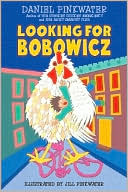
Looking for Bobowicz by Daniel Pinkwater

I've liked Daniel Pinkwater's writing ever since I was a kid, although I'm also the first to admit that he can be a little over-the-top with his plots. Looking for Bobowicz is one of his better books, a fun and fast-paced story about a kid who moves to Hoboken and gets mixed up in a mystery of a giant chicken and a phantom who steals bikes.

The writing is brisk and sure, a given when you're reading Pinkwater. It's also very funny. I loved Nick's parents, especially his dad, who provides a lot of the humor in the story.

I never figured out the mystery, although I thought I was getting close a few times (I wasn't). I thoroughly enjoyed the ride, though, and the solution was satisfying.

Powell's link (used book)

Wednesday, August 3, 2011

The Magic Thief: Found by Sarah Prineas

I think this is the conclusion of this particular trilogy, although I don't know for sure. It feels like a conclusion, anyway.

Apprentice wizard Conn is trying to find a way to protect the city of Wellmet--specifically, the city's magic, a living being--from a predatory magic. Conn is hampered since he still doesn't have his locus stone that allows him to work magic. He's also hampered by the city guards, who are convinced he's nothing more than a thief, and by the city's other wizards, who don't believe the magic is alive and don't believe it's under threat. With his mentor's help, Conn casts a spell to help him find his locus stone--a spell that leads him far away from Wellmet when the city needs him the most.

When I first read this book, I was a little disappointed. When Conn leaves the city, I didn't expect that part of the story to last so long. I kept itching for him to get back. But that was just me; now that I think about it, Conn's trip to find his Locus stone is a key part of the whole trilogy. That's where he discovers what the magic really is. I was just being impatient.

As always, I enjoy Conn's reticence and practicality along with his clever sense of wordplay. These are fun books to read and I daresay they'd be fun to read aloud. I hope there's more in this series, but even if there aren't, I like the ending a lot.

Powell's link

Saturday, June 25, 2011

Magic by the Lake by Edward Eager

This review will be short. I apologize for that. I'd go into why, but this isn't my personal blog.

I love Edward Eager's books, particularly Half Magic, which Magic by the Lake is a sequel to. Eager's style is purposefully similar to E. Nesbit, which he greatly admired, and his stories are charming, clever, inventive, and funny, with realistic children and magic that has unexpected consequences.

Unfortunately, Magic by the Lake is not nearly his best book. It's a bit too episodic, without much of an overarching plot to tie the magical events together. The children from Half Magic travel with their mother and stepfather to a lake for the summer, and almost immediately they discover a talking turtle who explains to them the rules for the lake's magic. Thereafter the children have adventures that include mermaids, pirates with buried treasure, and so forth.

It's a quick read, but unless you're just wanting to read everything Edward Eager ever wrote, you're much better off reading Half Magic without needing to read this one too.

B&N link

Thursday, June 2, 2011

Mus Musicus by Colin Hazlehurst

I saw this while browsing the kids' books for my Sony Reader and thought the cover and title were both clever. I bought it on impulse without realizing it was self-published. But it turned out to be a charming little book.

It follows a mouse family, the Muskers, who move into an abandoned house and make their nest in a piano. But the house doesn't stay abandoned for long. A woman with purple shoes has moved in--and soon after, a man arrives to tune the piano. The mice are terrified they'll be discovered, but at the same time they're fascinated by the sounds their home is making. Before long, the mice are imitating the music the purple-shoes woman plays.

It's a simple, sweet story for younger kids. It mostly follows Mr. Albert Musker's brother Charles and two of Albert's children, shy but observant Frances and adventurous George. I liked the mouse-eye view we get of the house and its furnishings, and the mouse-ish way the mice think. When Frances discovers what the pages of music are for, she explains to her family that the lines represent the piano wires while the notes represent where the mallets should strike the wires--a remarkably clever way to explain musical notation.

There's not a lot of tension in the book and what there is is small and not very scary: George struggling to climb all the way up the piano, Frances getting trapped behind a row of books, Charles deciding to show himself to the purple-shoes woman. It's perfect for younger, musical kids.

I almost said it's perfect for younger, musical kids who like mice--but everyone likes storybook mice.

B&N link (nook book)

Wednesday, June 1, 2011

The Fourth Stall by Chris Rylander

Sixth grader Christian, better known as Mac, can solve your problems. Need to get into an R-rated movie without being caught? Want that video game your parents won't let you have? Need the answers to a test? Mac can help you. For a price.

Mac and his best friend Vince run a little business from a disused bathroom in his K-8 school. They started it to help people, but they're also making a killing: specifically, almost $6,000 they're planning to use for baseball tickets in the unlikely event that the Cubs make it to the World Series. But...the Cubs are doing really well. This could be the year! The only problem is Fred, a nervous third grader who comes to Mac with a particularly tricky problem. The legendary figure of Staples is running a crooked book-making business in the area schools, and he's just expanded into Mac's school; Fred's a former bookie who wants out. He needs protection. But before long, Mac realizes he's in way over his head. If he can't take down Staples once and for all, Mac could lose his business, his money--and his best friend.

For the most part, the book is a lot of fun (and often very funny), especially the first section where Mac and Vince are discovering just who and what they're up against. But as the story progressed, I started to have more and more problems with it.

Nothing Mac and Vince do actually helps them--in fact, every single attempt they make to solve their increasing problems just makes things worse. It got to the point that I felt the hand of the author among all the misery, and I was right. They can't make progress because then they couldn't have the big showdown at the end.

But the showdown was lame. I was bitterly disappointed. In fact, the whole book turned into a Moral Lesson on seeing things from other people's points of view. And the point the whole book was building to, the "HELL YES" moment when the good guys triumph and the bad guys get taken down the way they tried to take down the good guys...it never came. Instead we get a few didactic paragraphs and an unsatisfying denouement about the Cubs.

Because of the lame ending, and the near-absence of girl characters in the book, I wouldn't give this to my nephews to read. I'm glad I bought it as an ebook, because if I'd dropped money for the hardback I'd be pissed. Oh, and the main character has the same first name as the author, which always bothers the hell out of me.

B&N link

Thursday, May 26, 2011

Carbonel, The King of the Cats by Barbara Sleigh

This is a charming book that reminded me a lot of E. Nesbit and Edward Eager. It was first published in 1955 and has been reprinted in a nice hardback edition with the original illustrations. I'd never read it before, but I would have just loved it as a kid.

Ten-year-old Rosemary plans to buy a broom so she can clean neighbors' houses over her summer break, intending to surprise her widowed mother with the money. But the broom she buys turns out to be a witch's, and along with it she acquires the witch's cat, Carbonel. But Carbonel is no ordinary cat. He's a prince who was catnapped from his cradle as a kitten. He needs Rosemary's help to return to his people.

The story is lively, inventive, and a complete delight. I read it in a few hours and enjoyed every word. Its portrayal of both children and cats is realistic and very funny, and I especially liked that everyone ends up better for their experience, even the witch. I think there are sequels, too.

B&N link

Tuesday, April 26, 2011

The Case of the Goblin Pearls by Laurence Yep

I've liked Laurence Yep's writing for years, ever since I read Dragon of the Lost Sea when I was a kid. Occasionally I pick up another of his books and I always enjoy them.

The Case of the Goblin Pearls is about twelve-year-old Lily Lew, who lives in San Francisco, and her Auntie, an actress who gained fame decades before as Tiger Lil but whose glamorous days are over. Auntie Lil comes to visit for Chinese New Year, mostly because she's organizing a parade float for a businessman whom she hopes might one day finance another Tiger Lil movie. But when a thief steals the famous Goblin Pearls, Lily and her Auntie end up digging into the mystery behind the theft. Not only do they uncover some shady goings-on in Chinatown, Lily learns a lot about what it means to be Chinese-American.

I liked the book, although it seemed a little rushed in the beginning while also taking a while for the actual plot to get underway. There's a lot of set-up for the whole series, not just this book. I would have liked to have a little more character development, too. But once the mystery really gets started, it's a lot of fun. Lily is roped into helping during the parade, and witnesses the theft of the pearls. She only decides to investigate when she realizes there's a connection between the pearls' owner and a sweatshop where the mother of a girl she knows works--a sweatshop that hasn't paid its workers in three months.

Oddly enough, the parts of the book I liked best were those where Lily was grappling with her own heritage and thinking about things she's always taken for granted. Another writer might have made this a Message book, but Yep handles the topic lightly. The glimpses of Chinese-American culture, particularly around Chinatown, are fascinating without overpowering the mystery. The book is for younger kids, so while the mystery isn't terribly hard to figure out, it's satisfying.

The book was published in 1997, and it's surprising how dated it feels. Lily's mother rents VCR tapes to show the family Tiger Lil's old films; when they can't find some of the movies, Lily asks a computer-nerd friend to check with his "connections on the Internet" to chase them down. It's a shame that the dated stuff shows up early in the book, because it's both distracting and not a bit important to the actual plot. I suppose if the book is ever reprinted it would be easy enough to update it.

B&N link (used book)

Sunday, March 13, 2011

The Great Brain Is Back by John D. Fitzgerald

I loved the Great Brain books when I was a kid, but I'd never read this one. It was published posthumously in 1995. It's another of my library sale finds.

The books are each a series of short stories about J.D., his older brother Tom, and their family. Tom is the one known as the great brain, and as J.D. points out, he also has a money-loving heart. Every time Tom comes up with another idea to make money, it seems J.D. ends up broke--but never bored.

When I was a kid, I thought Tom's swindling was hilarious. As an adult, I'm a lot less amused. Tom's kind of a jerk. I actually disliked the first story, where Tom orders a bunch of soap to resell and talks J.D. into selling it and paying Tom for the privilege. But the later stories are a lot better. Tom helps figure out the actual events when a Paiute Indian is accused of stealing a rifle, and he engineers the downfall of a man running a dogfighting ring. Best of all, in the last chapter Tom gets his comeuppance from an unexpected source.

The stories are mostly funny, but they're also interesting since they're set in the last year of the 19th century. Fitzgerald wrote the books based on his own childhood memories. The writing is simple but clear, and J.D. is a nice guy even if he is a little too willing to let Tom walk all over him.

B&N link

Friday, March 11, 2011

Poor Badger by K.M. Peyton

K.M. Peyton is the same writer as Kathleen Herald. Whatever name she writes under, I love her books. I've read this one several times, years ago, but picked up a copy at a library sale yesterday and reread it.

Nine-year-old Ros Palfrey is delighted when she discovers a black and white pony tethered in a field near her house. She and her friend Leo name the pony Badger and bring him carrots. But Badger, so spirited and healthy at first, is neglected by his owners--a mean girl and her family--and loses condition rapidly. Ros is horrified. As winter sets in and Badger gets thinner and scruffier, with no shelter from the cold, Ros decides to steal the pony to save his life.

Poor Badger is an exciting, beautifully written gem of a story. Badger's plight feels real because it's not overstated: the pony is neglected, but not so much so that the authorities should step in; in fact, Ros insists her father call the SPCA, who talk to the pony's owner about feeding him but do nothing more. The adults in the book are concerned about Badger, but only Ros decides to take action--even though she knows it's stealing.

Ros is a tough girl who plans ahead and thinks she's prepared for anything, while Leo is timid and slightly in awe of Ros. I love how their roles reverse during the big rescue, as Ros despairs after her plans go awry, and Leo discovers the excitement of being out alone at night. I also appreciate the aftermath of the theft, when Ros deals with the consequences of her actions and her continued worries for Badger's future.

The ending is perfectly satisfying. The ending also takes place on Christmas Eve, so the book would make a great Christmas gift for a horse-crazy kid. It's out of print, unfortunately, but good used copies aren't hard to come by.

B&N link

Thursday, March 10, 2011

The Mystery of Pony Hollow by Lynn Hall

Sometimes you just have to read a 59-page book about ponies. At least I do.

Sarah Elgin has a new pony of her own. She spends a sunny May Saturday exploring her parents' Iowa farmland on horseback, and discovers a tiny stone house in a hollow. To her horror, though, she hears a pony inside, whinnying and kicking at the door. But when Sarah breaks the lock to let the trapped pony out, she discovers the cottage is empty--except for a dusty pony skeleton.

For such a short, simple story, The Mystery of Pony Hollow packs a lot of action. I liked that Sarah didn't rely on adults to solve the mystery. She researches the history of the farm herself, discovers the name of a groom who worked there fifty years before and tracks him down at a nursing home, and goes to visit him herself.

The story is gentle and interesting, with a bittersweet but satisfying ending. I've read a lot of Lynn Hall's books over the years; they're always good.

B&N link

Monday, February 21, 2011

Listening for Lions by Gloria Whelan

I read a review of this book over at Book Aunt, where I get a lot of excellent book recommendations. I'm very glad I picked up a copy when I found one.

Rachel Sheridan was born and raised in Africa in a tiny village where her missionary parents run a small hospital. It's early 20th century, and the Spanish Influenza is sweeping the globe. Rachel's world is destroyed when her parents die of the flu and an unpleasant English couple take her in against her wishes. The English couple's daughter, Valerie, has also died, and Rachel looks enough like her that the parents think she could fool Valerie's grandfather, who has never actually met her. Rachel is shipped off to England with strict instructions to convince the grandfather to leave his estate to his ne'er-do-well son and daughter-in-law. She has to become Valerie, a girl who despised Africa as much as Rachel loves it.

Rachel's homesickness for Africa and her life there is moving and well realized. The reasons why she's afraid to tell the grandfather of the deception make sense, and her growing fondness for him and the English countryside make for a wonderful story. The writing is simple, clean, and descriptive.

The last section of the book, as Rachel grows older, was the weakest. It covers many years at a fast clip, skimming the important events of Rachel's life. The ending is satisfying, but the whole last section seems almost unnecessary. Still, it's a very good book and a fast read.

B&N link

Saturday, February 19, 2011

Mairelon the Magician by Patricia C. Wrede

I bought this book used; it's long out of print. I've read a lot of Patricia C. Wrede's books and enjoy her writing a lot. I was glad when I finally found a copy of Mairelon the Magician, particularly since it's set in the same world as Sorcery & Cecelia (which she wrote with Caroline Stevermer, whose books I also love).

Kim is a London street waif who's lived most of her life disguised as a boy. It's safer that way. When she's offered five pounds to break into a traveling magician's wagon and look for a certain silver bowl, she jumps at the chance. She doesn't even have to steal the bowl, just find where it's hidden. But when she's discovered, instead of turning her over to the police, the magician--that's Mairelon--offers to let Kim tag along as they leave London. Kim agrees, even though Mairelon is obviously a real magician, not a trick magician, and even though there's something strange going on about the silver bowl.

The book starts off strong. Kim's a feisty character who fears for her future, now that it's becoming increasingly obvious she's not a boy. Her relationship with Mairelon is quarrelsome but friendly; Mairelon himself turns out to be full of surprises as to who and what he really is. Wrede's lively writing is a lot of fun.

Everything rocks along just fine, in fact, until the big smash finish. At which point...good grief. The tension drops dead as every character in the book shows up and starts arguing or infodumping or both. Kim might as well not be in the last 75 pages of the book, because she literally does nothing despite an excellent set-up for her being the only character who might be able to help. All the set-up has no point, since a lot of coincidences take the place of plot. Then there's an unbelievably long section explaining what happened and why regarding the events of the book. It's boring boring boring boring boring boring boring. Seriously, it's boring. And unnecessary, which is the worst of it.

I was badly disappointed in the book, especially since the first two-thirds built everything up so well. I think there's a sequel, but I doubt I'll bother to chase down a copy.

B&N link

Friday, January 21, 2011

Goose Chase by Patrice Kindl

I didn't figure out until the very end of this book, when I read the "About the Author" paragraph, that this is the same author whose book Owl in Love I read and loved recently. Owl in Love was a quirky, surreal, satisfying fantasy. Goose Chase was a tedious mess. I can hardly believe the same author wrote both books.

Alexandria Aurora Fortunato has been a humble goose girl for her first fourteen years. She has a dozen geese and loves them like sisters. They're all she has left after her mother's death a few years before. Unfortunately, after Alexandria helps an old crone, she's cursed with great beauty, hair that showers gold dust instead of dandruff, and tears that turn into diamonds. Her comfortable life is turned upside down when both a prince and a neighboring king demand her hand in marriage--and lock her up in a tower until she makes her decision as to who she'll marry. Alexandria escapes with the help of her geese, but her troubles are only beginning.

Alexandria the goose girl is a horrible person. She screams at and abuses everyone, never thanks her geese although they basically do everything for her, and ignores good advice even when doing so is obviously a bad idea. She's also dumb as a stump, but since everyone else in the book is even dumber, that doesn't really matter. I put up with Alexandria's bad attitude because I was certain she'd learn kindness as part of her journey. She never does.

Although Alexandria is fourteen and the prince fifteen, the book seems intended for much younger children; but it's much too long for very young readers, no matter how precocious they are. There's a lot of inventive action, but even more long passages of Alexandria feeling sorry for herself and complaining. As an adult with a pretty good grounding in fairy tales, I didn't find the big plot reveals at the end surprising. I also found the romance between Alexandria and the prince both disappointingly predictable and completely unconvincing.

The book starts out fairly funny, but the humor is repetitive and soon becomes tiresome. I enjoyed Alexandria's stay with the ogresses--about the only thing about the book I did enjoy, actually, and it was marred by Alexandria's stupidity and ill nature. (Without spoilering anything, she could have gotten out of the situation easily if she'd thought for one second and stopped insulting everything within tongue-lashing range.) By the time the book was finished, I would have been happy if King Claudio the Cruel had beheaded Alexandria, the prince, all the geese, and every single other character.

Basically, author Patrice Kindl isn't all that great a writer. I didn't notice when I read Owl in Love because in that book, she's able to hide her shortcomings (clumsy characterization and stilted prose) in a story that actually uses them to an advantage--Owl is not human and doesn't think like a human, and she's cut off from normal society. Here, Alexandria is supposed to be a sympathetic character in an ordinary (fairy tale) world, and she just comes across as unlikable.

B&N link

Thursday, January 20, 2011

Henry Reed, Inc. by Keith Robertson

This book was first published in 1958, so it was already out of date when I read it as a kid. I never noticed. This was one of my favorite books when I was about ten. Recently I picked up a used copy and reread it, half dreading what I might find.

Fortunately, it's held up so well that with a few exceptions, it might as well have been written last year. Henry Reed is the son of a diplomat living in Naples; he's thirteen and has just arrived in the states to visit his aunt and uncle for the summer. They live in a tiny town near Princeton, New Jersey. It turns out that the only kid in town even close to his age is a twelve-year-old girl named Margaret Glass, who goes by Midge. With Midge's help, Henry sets up a research business in a barn to see if he can make money over the summer.

I'd most dreaded finding sexism that I didn't catch as a kid, but I was pleasantly surprised. Henry is never disparaging of Midge because she's a girl, only because she's younger than him and has a sense of humor he doesn't appreciate. She's not a girly-girl, either. The two of them have fun but realistic adventures, from trying (repeatedly) to capture Midge's escaped pet rabbit to rigging up their own weather balloon. The story is funny, the characters all likable, and the sensibilities surprisingly modern. I'm glad I reread it. Now I need to dig up the sequels.

B&N link